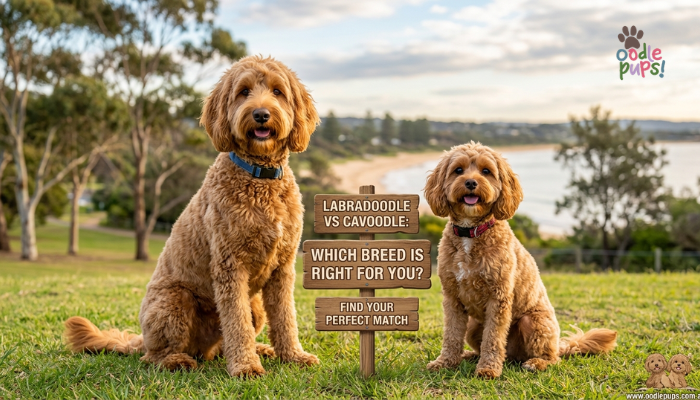

Labradoodles and Cavoodles are affectionate, intelligent family dogs, but the right choice comes down to your lifestyle. Labradoodles suit active households with space and time to spare. Cavoodles, by contrast, fit more naturally into quieter homes, smaller spaces, and first-time ownership.
Both breeds look similar on the surface. But energy levels, grooming demands, and behaviour around kids can vary a lot between the two.
At https://www.oodlepups.com.au, we’ve raised and worked closely with the two dog breeds, including our own Labradoodles Pip and Rosie. This guide breaks down what owners notice most after bringing their puppy home. You’ll learn:
- Temperament and personality
- Size and energy levels
- How each breed suits families, singles, and apartment living
- Grooming and ongoing costs
- Which breed is right for you
Let’s start with the basics.
Labradoodle vs Cavoodle: The Basic Differences
While Labradoodles and Cavoodles both share strong Poodle influence, they differ in size, build, and coat type. Even their origins come from different parent breeds, which influence how they behave today. Below, we break down these differences in more detail.
Breed Origins
The Labradoodle was first bred in Australia in the 1980s as a low-shedding guide dog for a vision-impaired woman whose husband had allergies. That original purpose influenced many of the breed’s defining traits, including its temperament, intelligence, and coat type.
The Cavoodle was developed for a similar reason. Breeders wanted to combine the gentle nature of the Cavalier King Charles Spaniel with poodle intelligence in a smaller companion dog.
Size and Build
Size is one of the main differences between the two breeds. Standard Labradoodles usually stand between 53 and 63cm tall and can weigh up to 30kg, although medium and miniature varieties are also common.
Cavoodles are much smaller overall. Because they’re not a formally standardised breed recognised by organisations such as the Australian National Kennel Council, their size can vary depending on parent lineage. Most adult Cavoodles weigh between 5 and 12kg.
Coat and Appearance
Both breeds carry a low-shedding coat thanks to their poodle genetics, but the texture varies even within the same litter. Labradoodles tend toward a fuller, more voluminous coat, while Cavoodles often have a softer, finer one. They also come in a wide range of colours, including cream, gold, chocolate, black, and parti-colour variations.
Temperament and Energy Levels
Labradoodles are energetic, fun-loving, and deeply people-oriented. They need at least an hour of exercise daily, and without enough mental stimulation, that energy turns into destructive behaviour pretty quickly.
Cavoodles, by comparison, are calmer and more laid back by nature. They need around 30 to 45 minutes of activity a day, which suits quieter households and first-time owners well.
The one thing to watch with Cavoodles is separation anxiety. Their Cavalier side makes them deeply social, so long hours alone are genuinely hard on them. If your household is out most of the day, that’s worth factoring in before you decide.
Family Life, Kids, and Other Pets
Both breeds are genuinely good with families, but the way they fit into a household can feel quite different.
Labradoodles are boisterous and playful by nature. That energy is a great match for active households with older kids who can keep up, but it can easily overwhelm toddlers or elderly family members.
Cavoodles, by contrast, are gentler and more patient, which makes them a natural fit for homes with young children or multiple pets. They also tend to handle noise, routine changes, and busy home environments more calmly.
Beyond family dynamics, the two breeds generally socialise well with other dogs and adapt comfortably to homes with multiple animals. That said, Cavoodles can carry a mild prey drive from their Cavalier side, so smaller animals are worth introducing carefully.
Despite their differences, both breeds share a strong attachment to the people around them. As long as their social and emotional needs are met, either breed can make a deeply affectionate companion for the right family.
Trainability and Intelligence
Both breeds are intelligent and trainable, but they learn differently and respond to different handling styles.
Labradoodles are highly intelligent and pick up commands quickly. One of their best traits is how intuitively they read human interaction. They often seem to sense what you need before you ask. That makes them easy to train from a young age, but it also means they get bored fast.
Without enough variety and challenge in their training sessions, they’ll usually find their own entertainment, which can quickly become problematic.
Cavoodles are equally eager but respond better to a calmer approach. They’re sensitive to tone, so harsh corrections tend to set them back rather than move training forward. That’s why short, positive training sessions work best, and most owners find them quite easy to train from an early age. As doodle breeds go, both are considered highly trainable companions.
Grooming Costs and Coat Care
Professional grooming for oodle breeds is usually needed every 6 to 8 weeks and can easily exceed $1,000 a year in Australia. New owners often underestimate this at first, only to realise it becomes a fixed part of their monthly routine.
With Pip and Rosie, we planned for those grooming costs from day one and built them into our regular care routine. As a result, we’ve never had surprise expenses or had to scramble to cover grooming bills. If you’re thinking along the same lines, these are the grooming commitments to be aware of before bringing a puppy home:
- Coat Maintenance: Both breeds need brushing several times a week to prevent matting, regardless of coat length. A low-shedding coat doesn’t mean a low-maintenance one.
- Professional Grooming: Book a groom every 6 to 8 weeks. Skipping appointments leads to matting that becomes painful for your dog and expensive to fix.
- Grooming Costs: It can cost around $80 to $120 per groom, depending on your location and the dog’s size. In most cases, Labradoodles sit at the higher end due to their larger build, so it’s important to factor this into your budget.
The earlier you start grooming your puppy, the easier every appointment gets. Pip and Rosie both sat calmly from their very first groom because we brushed them at home every day for the first two weeks.
If you build that habit early, grooming becomes much easier for you and your puppy as they grow.
Lifestyle and Living Situation
Your living situation will likely make this decision for you. Labradoodles need space, daily exercise, and an owner with time to match their energy. Cavoodles, meanwhile, fit more naturally into smaller homes and quieter routines.
Here’s how the two compare side by side:
| Labradoodle | Cavoodle | |
| Best Living Situation | House with a yard | Apartment or smaller home |
| Daily Exercise | 60+ minutes | 30 to 45 minutes |
| Best For | Active families | First-time owners, quieter households |
| Price Range (AUD) | $3,000 to $5,000 | $5,000 to $8,000 |
The one thing that catches most buyers off guard is the price. Cavoodles typically cost more upfront despite being the smaller breed, often by $2,000 or more. If budget is a factor, a Labradoodle is the more affordable entry point.
Just keep in mind that food and grooming costs are higher over time, so it tends to even out.
Bottom Line: If you have the space and an active lifestyle, a Labradoodle is the better fit. For quieter homes and first-time owners, a Cavoodle is often the stronger choice.
The Right Dog Breed for Your Household
Both the Labradoodle and Cavoodle are wonderful dogs. The difference is in what they need from you and whether your lifestyle can honestly meet that.
If you’re still weighing it up, asking these questions can help:
- Do you work long hours away from home?
- Are you in a house with a yard or a smaller space?
- Do you have an hour a day for exercise, or closer to 30 minutes?
- Are you a first-time dog owner or experienced?
The right dog is the one that fits your home, your routine, and your family long after the puppy phase is over. If you’re leaning toward a Labradoodle, Oodle Pups is a good place to start your search.