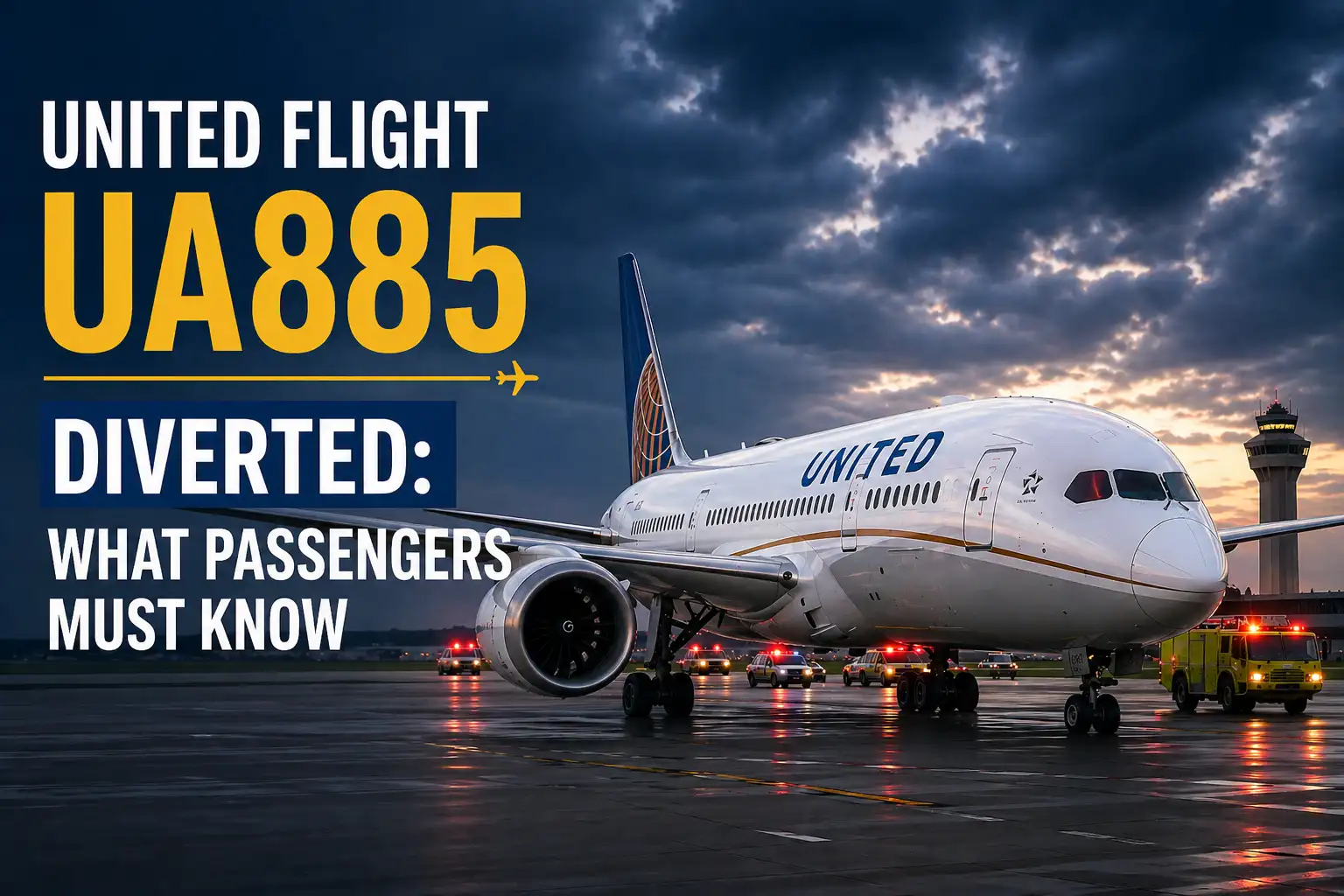

On November 4, 2025, United Airlines flight UA885 — also tracked as UAL885 — made headlines when it turned around mid-flight over Normandy and diverted to Paris Charles de Gaulle Airport instead of continuing to Washington Dulles. The aircraft — a Boeing 767-400ER registered N66056 — had departed Rome’s Leonardo da Vinci International Airport at 11:35 CET, expecting a standard nine-hour transatlantic crossing. What followed was anything but standard.
- What Happened to United Airlines Flight UA885?
- Why Did Flight UA885 Divert to Paris?
- Flight UA885 Route and Aircraft Details
- UA885 Flight History, On-Time Performance and Past Incidents
- On-Time Performance and Delay Statistics
- Notable Past Incidents on UA885
- Code-Share Partners for UA885
- Passenger Impact and What Happens After a Diversion
- Passenger Rights and Compensation for Diverted Flights
- US DOT Rules for Diverted Flights
- EU Regulation EC 261/2004 Explained
- Hotel, Meal Vouchers, and Additional Entitlements
- How to Track a Diverted Flight in Real Time
- Broader Impact of Flight Diversions on the Aviation Industry
- Conclusion
- FAQs
- FAQ 1: Why did United Airlines flight UA885 divert to Paris?
- FAQ 2: Where did UA885 land after the diversion?
- FAQ 3: What aircraft operates United Airlines flight UA885?
- FAQ 4: What are my passenger rights if my flight is diverted?
- FAQ 5: Can I get compensation for a diverted United Airlines flight?
- FAQ 6: How can I track a diverted flight like UA885 live?
- FAQ 7: How often does UA885 get delayed or diverted?
- FAQ 8: What should I do immediately if my United Airlines flight is diverted?
Whether you were onboard, tracking a loved one’s flight, or simply following the news, this breakdown covers everything: what happened, why it likely occurred, and what rights you have when a diversion disrupts your travel.
What Happened to United Airlines Flight UA885?
The flight departed Rome FCO on schedule and climbed to cruising altitude without incident. Somewhere over Normandy, at approximately 30,000 feet, the crew made a decisive call to reverse course toward Paris CDG rather than continue west toward Washington IAD.
United Airlines confirmed the diversion through official channels — an unusual step that typically signals a significant onboard situation rather than a routine weather reroute. Tracking platforms, including AirNavRadar, flagged the course change in real time, with the airline issuing two successive confirmations — UPDATE #1 acknowledging the diversion to CDG, and UPDATE #2 confirming touchdown — before the flight alert cleared. The aircraft landed safely on runway 8L at Charles de Gaulle Airport roughly three hours after takeoff.
Key facts at a glance:
| Detail | Information |
| Flight Number | UA885 / UAL885 |
| Aircraft | Boeing 767-400ER |
| Registration | N66056 |
| Departure | Rome FCO — 11:35 CET |
| Intended Destination | Washington Dulles (IAD) |
| Diversion Airport | Paris CDG |
| Landing Runway | 8L |
| Time to Divert | ~3 hours after departure |
The diversion over Normandy — before crossing the Atlantic — is operationally significant. Crews making that call before the ocean crossing have far more flexibility; once over open water, options shrink fast.
Why Did Flight UA885 Divert to Paris?
United Airlines confirmed the diversion but stopped short of disclosing the specific cause publicly. That’s not unusual. Airlines rarely release operational details in real time, and investigations often take days or weeks.
That said, diversions of this type typically fall into a handful of categories:
- Medical emergency — A passenger or crew member requiring urgent care that can’t wait nine hours over the Atlantic
- Mechanical or technical issue — A system alert or failure prompting the crew to land at the nearest suitable airport
- Operational constraint — Crew duty hour limits, fuel considerations, or aircraft issues
- Airspace or weather factors — Less common for a pre-ocean diversion, but not impossible
Under international aviation law, the pilot-in-command holds full authority to divert at any point — a power that exists precisely for situations like this. The fact that the turnaround happened over Normandy — before the aircraft committed to the transatlantic segment — suggests the crew identified the problem early enough to choose Paris CDG deliberately rather than declaring a full emergency. FlightAware and Flightradar24 tracking data showed the aircraft changed course smoothly, without the erratic flight path typically associated with rapid depressurization or engine failure.
No injuries were reported. The airline’s decision to confirm the diversion promptly points toward a controlled, precautionary response rather than an emergency in the acute sense.
Flight UA885 Route and Aircraft Details
UA885 — also referenced as UAL885 and UA0885 — operates daily between Rome Fiumicino (FCO) and Washington Dulles (IAD), running every day of the week: Monday through Sunday without exception. The route covers approximately 7,232 km (4,494 miles) at an average cruising speed of 799 km/h (497 mph), making it a standard long-haul transatlantic service.
The aircraft type assigned to this route — the Boeing 767-400ER — seats 231 passengers across three cabins:
- Polaris Business Class — United’s premium long-haul product with lie-flat pods
- Premium Plus — Recliner seats with enhanced pitch and service
- Economy Plus / Standard Economy — Main cabin with 48 Economy Plus seats at the forward end
The flight also operates under five code-share agreements: AC3750 (Air Canada), LH9362 (Lufthansa), LX3030 (Swiss), OS7919 (Austrian), and SN8946 (Brussels Airlines) — all Star Alliance partners. Passengers booked through any of those carriers were equally affected by the diversion.
UA885 Flight History, On-Time Performance and Past Incidents
On-Time Performance and Delay Statistics
By most measures, UA885 performs reliably. Airportia data shows an on-time performance rating of 5/5 stars based on the most recent 10 tracked departures, with roughly 10% of flights experiencing delays averaging around 19 minutes. Those numbers sit well within industry norms for a transatlantic route.
The November 2025 diversion is an outlier — not a pattern.
Notable Past Incidents on UA885
This route has seen incidents before. In July 2022, a United B772 operating as UA885 experienced a galley leak over the Atlantic, prompting crew attention mid-flight. Both events appear in The Aviation Herald’s public incident log. Earlier, in April 2024, a separate UA885 departure from Rome — operated by a Boeing 777-200ER registered N209UA with Pratt & Whitney PW4090 engines — suffered a compressor stall during climb. The crew heard a loud bang, stopped the ascent at 4,000 feet, performed holding patterns to burn off fuel, and returned to Rome safely. No injuries occurred.
The Aviation Herald documented both incidents. Neither escalated beyond a precautionary response, reinforcing that UA885’s crew has consistently followed protocol under pressure.
Code-Share Partners for UA885
Passengers on this route may have booked through Lufthansa (LH9362), Air Canada (AC3750), Swiss (LX3030), Austrian (OS7919), or Brussels Airlines (SN8946). For diversion-related rebooking, contact your ticketing carrier directly — their policies may differ from United’s on compensation response timelines.
Passenger Impact and What Happens After a Diversion
Immediate Impact on Passengers
Landing in Paris instead of Washington creates a cascade of problems. Connecting flights get missed. Accommodation needs to be arranged. Ground transfers, baggage retrieval, and rebooking onto the next available Washington service all take time — often stretching into the following day.
For a nine-hour long-haul like Rome to Washington, the knock-on effects are proportionally larger. Passengers arriving in Paris face the full length of their original journey still ahead of them, minus the hours they’ve already spent onboard.
Airlines typically bear costs for rebooking, hotel stays, and meals when the diversion falls within their operational control. That classification matters significantly for what you can claim.
What To Do If Your United Airlines Flight Is Diverted
Acting quickly makes a real difference. Here’s a practical sequence:
- Stay calm and listen to the crew — The cabin team will give instructions on deplaning, baggage, and next steps. Follow them before doing anything else.
- Contact United Airlines immediately — Use the United app, call the MileagePlus service line, or head to the airport assistance desk. Rebooking priority often goes to passengers who reach the airline first.
- Document everything — Photograph your boarding pass. Save every receipt — hotel, meals, transport. These become your evidence if you file a compensation claim.
- Request accommodation and meals — If the diversion was within United’s control, you’re entitled to vouchers. Ask directly at the airport desk before leaving the terminal.
- File a compensation claim — Use United’s online portal or submit through the relevant regulatory body, depending on your departure location.
Passenger Rights and Compensation for Diverted Flights
US DOT Rules for Diverted Flights
The Department of Transportation strengthened passenger protections in 2024. Under current rules, refunds must be automatic, issued within seven business days for credit card purchases, and paid in cash or the original form of payment — not travel credits unless you consent.
The passenger bill of rights also mandates that during tarmac holds, airlines must provide food and water, lavatory access, and medical attention to anyone who needs it. One important nuance: the DOT generally does not treat diversions the same as cancellations. Because the flight technically departed and operated partially, refund entitlement depends on whether you were able to complete your journey. If United rebooked you successfully, a refund may not apply — but meal and hotel coverage can still be owed.
Tarmac delay rules also apply: domestic flights can’t hold passengers more than three hours, international flights no more than four, without offering deplaning options.
EU Regulation EC 261/2004 Explained
Because UA885 departs from Rome — an EU airport — European passenger rights regulation EC 261/2004 applies regardless of the airline’s nationality. The regulation covers delays exceeding three hours, outright cancellations, and significant diversions. It applies based on the departure airport, though arrival-side jurisdiction can also be a factor in some cross-border cases.
Compensation tiers under EU261:
| Route Distance | Compensation Amount |
| Under 1,500 km | €250 |
| 1,500–3,500 km | €400 |
| Over 3,500 km | €600 |
The Rome-to-Washington route exceeds 3,500 km, placing eligible passengers in the €600 tier — provided the disruption wasn’t caused by extraordinary circumstances beyond the airline’s control. Medical emergencies typically qualify as extraordinary; mechanical failures generally do not.
UK261 mirrors EC 261/2004 for flights departing UK airports.
Hotel, Meal Vouchers, and Additional Entitlements
Under both the US and EU frameworks, passengers are entitled to “right to care” provisions when delays extend beyond a threshold:
- Meals and refreshments proportionate to the wait
- Hotel accommodation if an overnight stay becomes necessary
- Ground transport between the airport and the hotel
These apply regardless of the diversion cause in most EU scenarios. Under US rules, entitlement depends more on whether the situation was within the airline’s control. Keep all receipts — even if the airline provides vouchers, documented out-of-pocket expenses strengthen any follow-up claim under the Montreal Convention.
Depending on your nationality and departure point, additional regulatory frameworks may also apply — including US Goodwill policies, Canada’s Montreal Convention implementation (CA), Brazil’s ANAC regulations (BR-ANAC), Saudi Arabia’s GACA, and Turkey’s SHY framework. Filing through United’s online portal typically initiates a claim review within a documented timeline. If the response is unsatisfactory, a DOT complaint can escalate the matter through federal channels.
How to Track a Diverted Flight in Real Time
Flight tracking platforms give passengers and family members real-time visibility that airlines sometimes lag on. The most reliable options:
- FlightAware — Detailed route playback, historical data, and diversion alerts
- Flightradar24 — Live map with ADS-B coverage, useful for watching course changes as they happen
- FlightStats — Strong for delay data and connecting flight impacts
- AirNav Radar — Solid alternative with registration-level search (useful for finding N66056 directly)
- Plane Finder — A reliable alternative with solid radar coverage across European airspace
All major platforms pull ADS-B data and refresh real-time position every few seconds — fast enough to catch ATC-directed course changes as they happen. When a flight squawks 7700 — the universal emergency transponder code — tracking platforms typically display it within seconds. Watching for unusual route changes, holding patterns, or sudden altitude drops gives early signals before any official airline announcement.
Broader Impact of Flight Diversions on the Aviation Industry
Diversions are rare but costly. The US airline industry collectively recorded a diversion rate of approximately 0.33% in 2024 — low in relative terms, but each event carries significant financial weight.
For the airline: fuel costs spike, crew duty hour limits may be triggered, aircraft go out of position, and rebooking cascades across an entire day’s operation. For transatlantic routes like Rome-Washington operated by aging Boeing 767 fleets — United plans to retire its entire 767 fleet by 2030 — the pressure to maintain reliability is high.
Reputationally, how airlines handle diversions matters as much as the diversion itself. Passengers who receive clear communication, swift rebooking, and proper care recover their trust faster. Those left without information or accommodation rarely forget the experience. Aviation safety frameworks — and the networks that report on them in real time — play a key role in maintaining public accountability when these events occur.
Conclusion
The UA885 diversion on November 4, 2025, serves as a real-world reminder that even well-operated transatlantic routes can change course unexpectedly. The aircraft landed safely at Paris CDG runway 8L, no injuries were reported, and United confirmed the diversion promptly — all signs of a crew and airline that handled the situation by the book.
If you were affected, know your rights under EC 261/2004, document every expense, and contact United directly for rebooking and voucher support. Real-time tracking tools like FlightAware and Flightradar24 can help you stay ahead of future disruptions. And when traveling on long-haul international routes, travel insurance that covers diversion-related costs is worth every penny.
FAQs
FAQ 1: Why did United Airlines flight UA885 divert to Paris?
United Airlines confirmed the diversion but has not publicly disclosed the specific reason. Common causes for this type of pre-Atlantic diversion include a medical emergency onboard, a mechanical or technical issue, or an operational constraint. The crew decided on Normandy, before committing to the transatlantic crossing, which points to a controlled and precautionary response.
FAQ 2: Where did UA885 land after the diversion?
The aircraft landed at Paris Charles de Gaulle Airport on runway 8L, approximately three hours after departing Rome FCO. The landing was confirmed as safe, with no reports of injuries among passengers or crew.
FAQ 3: What aircraft operates United Airlines flight UA885?
UA885 operates on a Boeing 767-400ER configured with 231 seats across three cabins — Polaris Business, Premium Plus, and Economy (including 48 Economy Plus seats). The aircraft involved in the November 2025 diversion carried registration N66056.
FAQ 4: What are my passenger rights if my flight is diverted?
Rights depend on your departure location. Departing from an EU airport like Rome FCO, EC 261/2004 applies — covering compensation up to €600 and right to care provisions. From a US airport, DOT regulations govern refund eligibility and tarmac protections. Both frameworks require airlines to provide meals and accommodation when diversions extend the journey significantly.
FAQ 5: Can I get compensation for a diverted United Airlines flight?
Possibly, yes. Under EU261, if the diversion was caused by a mechanical failure and not an extraordinary circumstance, you may be entitled to up to €600. Under US DOT rules, automatic refunds apply in specific scenarios. File your claim through United’s online portal or contact the relevant aviation authority in your departure country.
FAQ 6: How can I track a diverted flight like UA885 live?
Use FlightAware, Flightradar24, FlightStats, or AirNav Radar. Search by flight number (UA885) or aircraft registration (N66056). A squawk 7700 transponder code signals an emergency and appears on tracking platforms almost instantly, often before any airline announcement.
FAQ 7: How often does UA885 get delayed or diverted?
UA885 holds a 5/5 on-time performance rating on Airportia based on recent flight data. About 10% of departures experience delays, averaging 19 minutes — well within normal ranges for a transatlantic route. The November 2025 diversion is an exceptional event, not representative of the route’s typical reliability.
FAQ 8: What should I do immediately if my United Airlines flight is diverted?
Listen to the cabin crew first. Then contact United Airlines directly — through the app, service line, or airport desk — to begin rebooking. Request hotel and meal vouchers at the terminal before leaving. Save all receipts and document your boarding pass and flight details, as these support any compensation claim you file afterward.