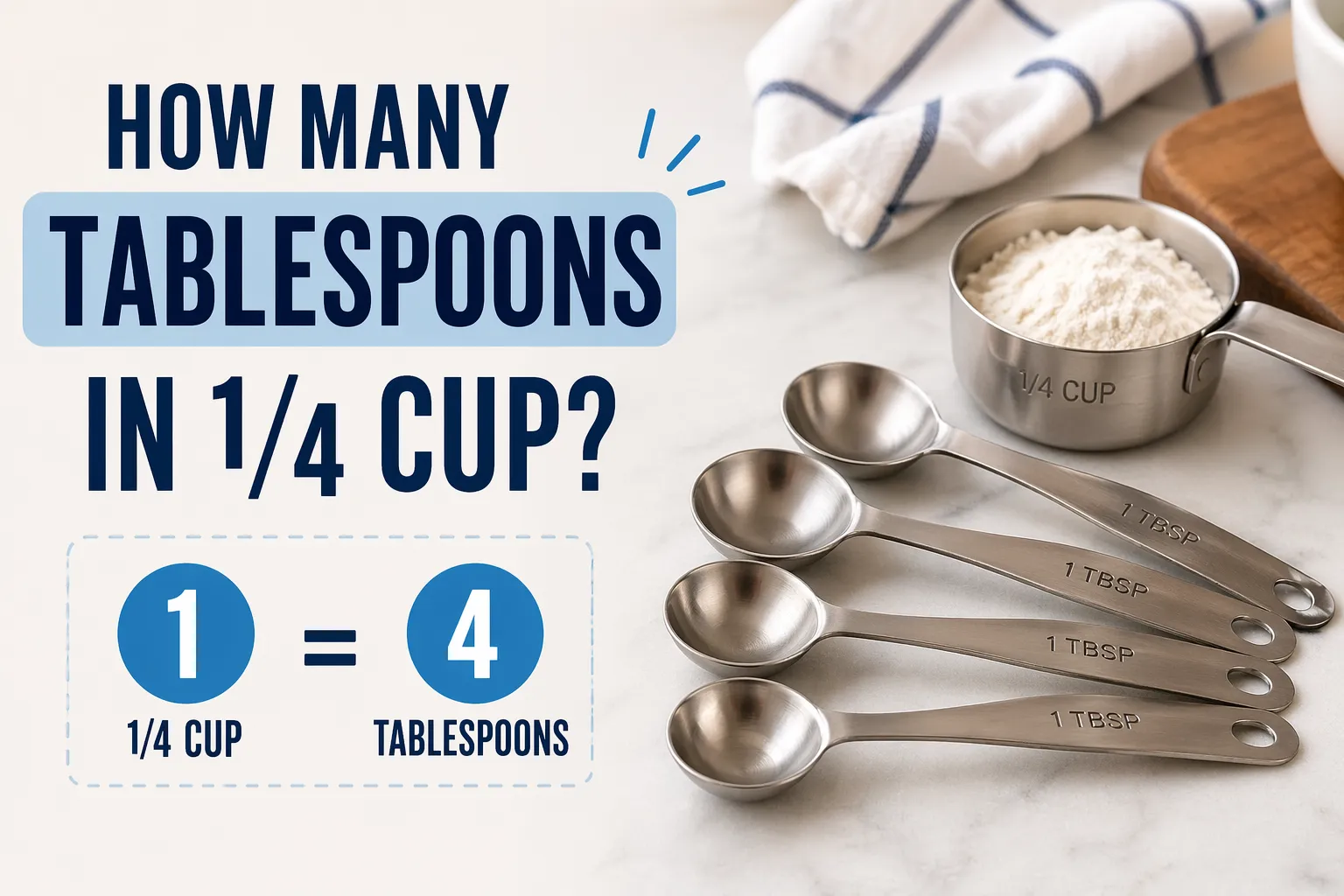

If you’re mid-recipe and your ¼ cup is nowhere in sight, the answer is simple: there are 4 tablespoons in ¼ cup. That’s the short version. But understanding why this works — and how to apply it across different recipes, ingredients, and even different countries — will make you far more confident in the kitchen.
- How Many Tablespoons Are in ¼ Cup?
- What Is a Tablespoon?
- What is a ¼ Cup?
- The US Conversion Formula
- Quarter Cup and Tablespoon Conversion Chart
- Tablespoons to Quarter Cups — Reverse Conversion Table
- Types of Measuring Cups and Spoons
- Imperial System vs. Metric System
- Tablespoons Around the World — International Variations
- Tips for Accurate Measuring in the Kitchen
- Sift Dry Ingredients
- Level Off Cups and Spoons
- Understand Ingredient Densities
- Keep Conversion Charts Handy
- Keep a Record of Your Adjustments
- Conclusion
- (FAQs)
- How many tablespoons are in ¼ cup?
- How many quarter cups are in 1 tablespoon?
- How many tablespoons are in ¼ cup of butter?
- How many tablespoons are in ¼ cup of flour?
- How many tablespoons are in ¼ cup of water?
- Is ¼ cup the same in the US and the UK?
- What can I use if I don’t have a ¼ cup measuring cup?
- How do I accurately measure ¼ cup of dry vs. liquid ingredients?
Whether you’re cooking a weeknight dinner or baking from scratch, precise measurements are the difference between a dish that works and one that doesn’t. Knowing how to convert between units of measure — and having the right tools and equipment on hand — sets you up for consistent kitchen success. This guide covers everything from the basic conversion to practical measuring tips that most articles skip entirely.
How Many Tablespoons Are in ¼ Cup?
4 tablespoons equal exactly ¼ cup. This holds for both liquid and dry ingredients in the US customary system.
Here’s the logic: one full cup contains 16 tablespoons. Divide that by four, and you get 4 tablespoons per quarter cup. You can also work it the other way — multiply by 4 to convert quarter cups back into tablespoons. That relationship stays consistent no matter what you’re measuring — flour, butter, olive oil, or honey.
If a recipe calls for ¼ cup and you only have tablespoons on hand, measure out 4 level tablespoons. The result is identical. It also works in reverse — if you see 4 tablespoons listed in a recipe, grab your ¼ cup measure and fill it once.
What Is a Tablespoon?
A tablespoon is a standard unit of volume in the US customary system, commonly abbreviated as tbsp, tbs, or T. It equals 3 teaspoons, 1/16 of a cup, approximately half a fluid ounce, and around 15 mL (some sources cite 14.79 milliliters).
Tablespoons work well for both dry and liquid ingredients. You’ll see them used for:
- Dry ingredients: sugar, salt, flour, cocoa powder, baking powder, baking soda, cream of tartar, dried herbs and spices
- Liquid ingredients: vanilla extract, honey, maple syrup, olive oil, mustard, mayonnaise
For dry ingredients, scoop and level off with a flat edge for precision. For liquids, fill the spoon to the brim without letting it round over the top. This standardization is recognized across North America, Europe, and Asia — which is why tablespoon measurements show up in recipes from virtually every cuisine.
What is a ¼ Cup?
A quarter cup — written as ¼ c — is one-fourth of a standard US cup. It equals 2 fluid ounces or approximately 59 milliliters in the metric system.
It’s one of the most common small measurements in cooking. Recipes use it for both liquid and dry ingredients, from broth to shredded cheese to chopped nuts. When a recipe calls for a small but meaningful amount, ¼ cup is usually the go-to measurement.
In countries that use the metric system, you’d express this as roughly 60 mL. That small rounding difference rarely matters in everyday cooking, but in precise baking, it can.
The US Conversion Formula
The math behind this conversion is straightforward:
1 cup = 16 tablespoons ¼ cup = 16 ÷ 4 = 4 tablespoons
Written as a formula: 0.25 × 16 = 4
This equation applies universally across all US recipe measurements. Once you internalize this, converting any fraction of a cup becomes quick mental math:
| Cup Fraction | Tablespoons |
| ⅛ cup | 2 tbsp |
| ¼ cup | 4 tbsp |
| ⅓ cup | 5 tbsp + 1 tsp |
| ½ cup | 8 tbsp |
| ¾ cup | 12 tbsp |
| 1 cup | 16 tbsp |
Quarter Cup and Tablespoon Conversion Chart
Whether you’re doubling a batch of cookies or cutting a sauce recipe in half, knowing these conversions helps you scale accurately and achieve the desired results without guessing.
| Cups | Tablespoons |
| ¼ c | 4 Tbsp |
| ½ c | 8 Tbsp |
| ¾ c | 12 Tbsp |
| 1 c | 16 Tbsp |
| 1¼ c | 20 Tbsp |
| 1½ c | 24 Tbsp |
| 1¾ c | 28 Tbsp |
| 2 c | 32 Tbsp |
Scaling a recipe up or down gets much easier when you keep a chart like this nearby. Many experienced cooks tape a version of it inside a kitchen cabinet door — a small habit that saves real time.
Tablespoons to Quarter Cups — Reverse Conversion Table
Sometimes the conversion runs the other direction. If a recipe lists tablespoons but you want to use a quarter cup measure, divide the tablespoon count by 4. To go the other way, multiply by 4 — that’s the full formula for converting between these two units in either direction.
| Tablespoons | Quarter Cups |
| 1 tbsp | ¼ of a quarter cup |
| 2 tbsp | ½ quarter cup |
| 3 tbsp | ¾ quarter cup |
| 4 tbsp | 1 quarter cup |
| 5 tbsp | 1¼ quarter cups |
| 6 tbsp | 1½ quarter cups |
| 7 tbsp | 1¾ quarter cups |
| 8 tbsp | 2 quarter cups |
This reverse table is especially useful when you’re scaling down a recipe. If the original calls for 8 tablespoons of an ingredient and you want to make half the batch, that’s 4 tablespoons — or one quarter cup, clean and simple.
Types of Measuring Cups and Spoons
Accurate measurements start with using the right tools. Measuring spoons are a kitchen must-have — available in various sizes and designed for precise measurement. Leveling off ingredients correctly is just as important as choosing the right tool.
Dry Measuring Cups
Dry measuring cups — also called granulated measuring cups — are designed to be filled to the brim and leveled off. They come in nested sets that typically include ¼, ⅓, ½, and 1 cup sizes.
Use these for flour, sugar, cocoa powder, oats, nuts, chocolate chips, rice, beans, and similar dry goods. The correct technique is to spoon the ingredient into the cup (don’t scoop directly from the bag for flour) and sweep a straight edge across the top. Scooping flour down can add 20–30% more than intended.
Liquid Measuring Cups
Liquid measuring cups have a spout for easy pouring and clear markings along the side — including quarter-cup markings on most standard models — making them spill-free to use when you keep them steady on a flat surface. Check the measuring line at eye level, not from above. Looking down at the cup distorts the reading.
These work well for milk, broth, olive oil, syrups, and water. Many include both fluid ounce and milliliter markings, which helps when working with international recipes.
Adjustable Measuring Cups and Spoons
Adjustable measuring cups use an adjustable slider mechanism to set the exact volume needed. Adjustable measuring spoons work similarly with a movable piece that lets you dial in different amounts with one tool. These are space-saving and versatile — useful if you cook often but prefer minimal equipment.
Digital Kitchen Scale
A digital kitchen scale is the most precise measuring tool available, particularly for baking. Rather than relying on volume, it measures by weight in grams or ounces — invest in a reliable scale that handles a wide range of weights for the most consistent results.
Always use the tare (zero out) function before adding each ingredient — place your bowl on the scale, hit tare, and the reading resets to zero so the bowl’s weight doesn’t count. This removes the variability inherent to volume measurements, especially for ingredients like flour, where density varies significantly depending on how it’s packed.
Imperial System vs. Metric System
The US uses the Imperial system, where volume is measured in teaspoons, tablespoons, cups, pints, quarts, and gallons, and weight in ounces and pounds. Most other countries use the Metric system, which measures volume in milliliters and liters, and weight in grams and kilograms. Because the Metric system is built on multiples of ten, many cooks find it easier to scale mathematically.
This versatility across systems is why home cooks working from cross-border recipes benefit from measuring tools that show both Imperial and Metric markings. For everyday cooking, the two systems are close enough to swap with minimal conversion. For precise baking, small differences add up.
¼ US Cup in Imperial and Metric Units
Below is a full breakdown of what ¼ US cup looks like across the most commonly used measurement units worldwide:
| Unit | Equivalent to ¼ US Cup |
| Tablespoons (US) | 4 tbsp |
| Teaspoons (US) | 12 tsp |
| Fluid ounces (Imperial) | 2 fl oz |
| Milliliters (Metric) | ~59.15 mL |
| Liters (Metric) | ~0.05915 L |
| Pints (Imperial) | 0.125 pt |
| Quarts (Imperial) | 0.0625 qt |
| Gallons (Imperial) | 0.015625 gal |
Keep in mind that these conversions are approximations. When precision is vital, using a kitchen scale is always the safer choice.
Tablespoons Around the World — International Variations
One tablespoon is not universally the same. Different countries — and regions within the European Union — define tablespoon volume differently, which affects how many fit into a ¼ US cup.
| Country/Region | Equivalent of ¼ US Cup |
| United States, Canada | 4 tablespoons |
| United Kingdom, Australia, New Zealand | ~3 tablespoons |
| Germany, Japan, South Africa, Sweden, the Netherlands | 4 tablespoons |
| France | ~4.7–4.8 tablespoons |
| Russia | ~4.2 tablespoons |
The US standard tablespoon equals 15 mL. The UK and Australian tablespoon equals 20 mL — making it noticeably larger. That difference explains why a recipe from a British cookbook might call for 3 tablespoons, where a US recipe would use 4 for the same quantity.
When working with recipes from different regions, always double-check which tablespoon size is assumed — particularly in baking, where these variations can affect final results.
Tips for Accurate Measuring in the Kitchen
Good ingredients mean little if the measurements are off. Before you start, make sure all your cups and spoons are clean and dry — moisture on a dry cup causes dry ingredients to stick and throw off the measurement. A few consistent habits prevent the most common errors, help you double-check your quantities, and consistently produce a perfect dish with the right recipe outcome.
Sift Dry Ingredients
Flour, sugar, and cocoa powder can clump or settle during storage. Sifting before measuring breaks up those clumps and produces a lighter, more uniform texture. It also helps ingredients mix more evenly in batters and doughs — a small step that noticeably improves the final result.
Level Off Cups and Spoons
A level tablespoon and a heaping tablespoon are not the same thing. When a recipe calls for 1 tablespoon, it means a level tablespoon. Use the straight edge of a knife, a spatula, or a bench scraper to sweep off the excess. This applies to both cups and spoons for dry ingredients.
Understand Ingredient Densities
Volume and weight are not the same. A cup of flour weighs roughly 120–130 grams; a cup of granulated sugar weighs around 200 grams. Even ¼ cup of butter, water, and honey each weigh differently — because their densities differ. When a recipe needs high precision, weighing by grams is more reliable than measuring by volume.
Keep Conversion Charts Handy
A printed conversion chart — or a kitchen app on your phone — saves time and prevents errors when working across recipes from different sources. Cups to ounces, tablespoons to grams, Fahrenheit to Celsius — having these references within reach is a practical habit, not a crutch.
Keep a Record of Your Adjustments
If you regularly modify recipes — scaling them up, substituting ingredients, or adjusting ratios — keep a short kitchen journal. Note what worked, what didn’t, and how you changed the measurements. Over time, this builds a reliable personal reference that’s far more useful than starting from scratch every time.
Conclusion
There are 4 tablespoons in ¼ cup — a conversion that applies consistently across all ingredients in the US customary system. Whether you’re a seasoned baker or an everyday cook, this single relationship unlocks a lot of practical flexibility.
Understanding the formula, knowing your tools, and accounting for international measurement differences will sharpen your accuracy in the kitchen. Keep a conversion chart nearby, use the right cup type for each ingredient, and measure with intention. Precise measurements aren’t about being rigid — they’re about getting reliable results every time.
(FAQs)
How many tablespoons are in ¼ cup?
There are 4 tablespoons in ¼ cup. This is a fixed conversion in the US customary system and is widely used in both cooking and baking for consistent, reliable results.
How many quarter cups are in 1 tablespoon?
One tablespoon equals ¼ of a quarter cup. To convert tablespoons to quarter cups, divide the number of tablespoons by 4.
How many tablespoons are in ¼ cup of butter?
A quarter cup of butter equals 4 tablespoons. This measurement remains constant across recipes and is the standard used in most US baking instructions.
How many tablespoons are in ¼ cup of flour?
A quarter cup of flour equals 4 tablespoons. For best accuracy, spoon the flour into the measuring cup and level it off — don’t pack it or scoop directly from the bag.
How many tablespoons are in ¼ cup of water?
A quarter cup of water is equal to 4 tablespoons or approximately 59 mL. This conversion applies to all liquids, ensuring consistency in measurements regardless of the recipe.
Is ¼ cup the same in the US and the UK?
Not exactly. A US tablespoon is 15 mL, while a UK tablespoon is 20 mL. This means ¼ US cup equals about 4 US tablespoons, but only around 3 UK tablespoons. When following recipes from different countries, always verify which tablespoon size is being used.
What can I use if I don’t have a ¼ cup measuring cup?
Use 4 level tablespoons as a direct substitute. Measuring spoons are widely available and provide the same volume as a ¼ cup measure when used correctly. As a conversion workaround, this is one of the most practical kitchen tips for mid-recipe situations — an adjustable measuring cup is another reliable option.
How do I accurately measure ¼ cup of dry vs. liquid ingredients?
For dry ingredients, use a nested dry measuring cup — fill it to the top and level off with a straight edge. For liquids, use a measuring cup with a spout, place it on a flat surface, and check the measurement at eye level. Using the correct cup type for each category and applying this precise technique ensures the most accurate results every time.