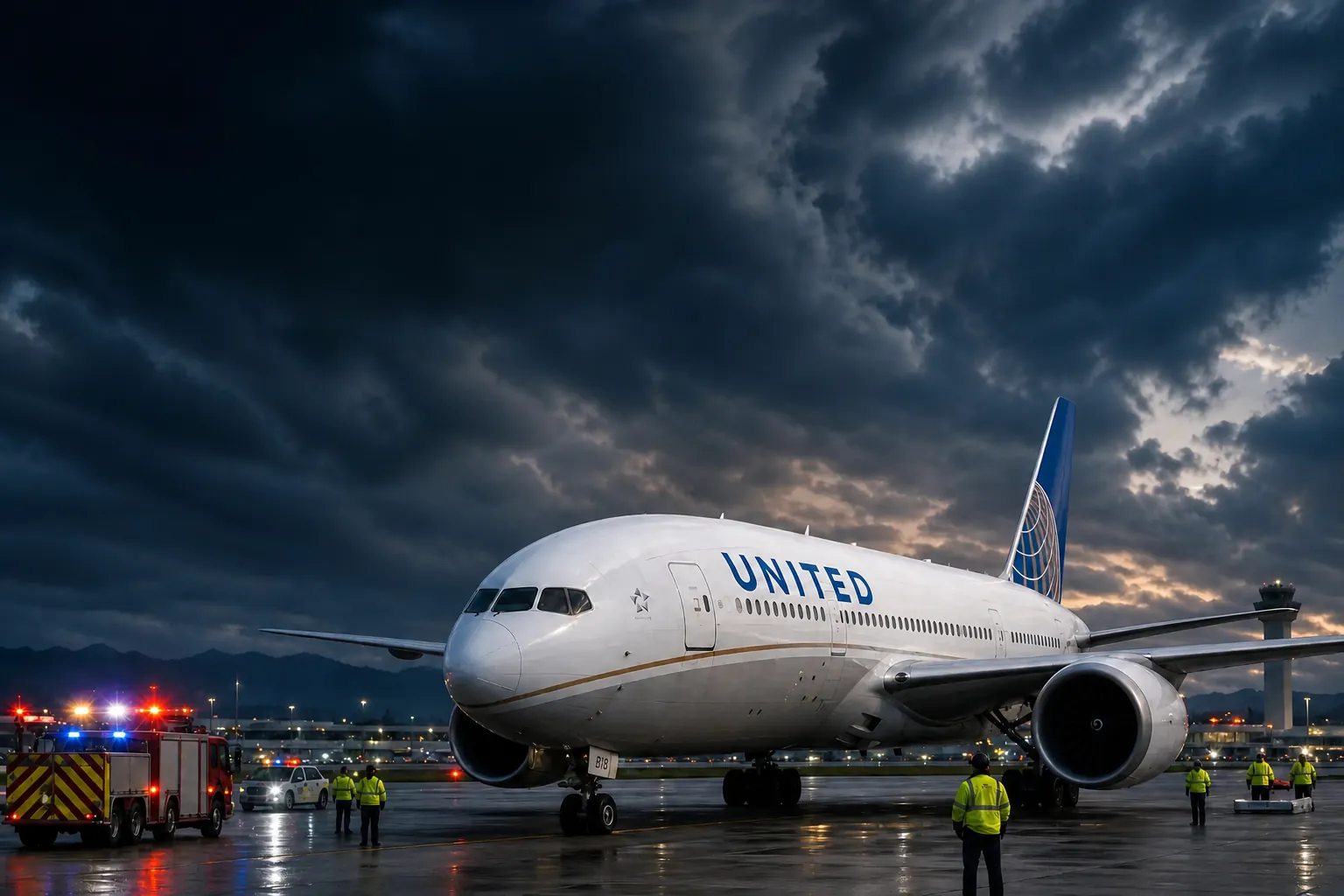

In late August 2025, United Flight UA967 diverted unexpectedly during its transatlantic crossing from Naples, Italy, to Newark Liberty International Airport. The aircraft landed at St. John’s International Airport in Newfoundland, Canada — far from its intended destination — after the experienced crew detected a technical issue mid-ocean. Safety measures were activated immediately, and the airline’s mechanical reliability protocols ensured the situation never escalated.
- What Is United Flight UA967?
- What Happened — The UA967 Diversion Explained
- Why Was United Flight UA967 Diverted?
- Decision-Making Process in the Cockpit
- Passenger Experience During the Diversion
- Replacement Aircraft and Continuation to Newark
- Operational Impact on United Airlines
- Role of Air Traffic Control
- Aviation Safety Protocols and Safety Culture
- Aircraft Monitoring Systems
- ETOPS Compliance and Regulatory Framework
- Crew and Airline Safety Preparedness
- What Passengers Should Do During a Flight Diversion
- Post-Incident Procedures and Lessons Learned
- Broader Implications for Transatlantic Flight Reliability
- Conclusion
- FAQs
- FAQ 1: Why was United Flight UA967 diverted?
- FAQ 2: Where was United Flight UA967 diverted to?
- FAQ 3: Were any passengers injured during the UA967 diversion?
- FAQ 4: How long was the total delay for UA967 passengers?
- FAQ 5: What is ETOPS, and how did it apply to UA967?
- FAQ 6: What rights do passengers have when a flight is diverted?
- FAQ 7: How did United Airlines handle the diversion operationally?
- FAQ 8: Could the UA967 diversion have been avoided?
The significant delay that followed was frustrating for passengers, but the outcome was never in doubt. No one was injured, and every traveler eventually reached Newark. But the incident raised real questions: what triggered the diversion, how did the crew respond, and what does this mean for passengers on long-haul flights?
Here is a clear, factual breakdown of everything that happened.
What Is United Flight UA967?
UA967 is a scheduled international long-haul route operated by United Airlines, connecting southern Italy to the northeastern United States — one of many major global destinations the carrier serves across the Atlantic. The flight typically uses a Boeing 767-300, a wide-body aircraft built specifically for transatlantic routes, offering a balance of range, passenger comfort, and operational efficiency.
It carries both leisure and business travelers across thousands of miles of open ocean, relying on precise flight planning, modern avionics, and multiple safety redundancies built into the aircraft itself.
On the day of the incident, the aircraft had already departed Naples three hours behind schedule — placing passengers in a difficult position before the flight even crossed into the Atlantic.
What Happened — The UA967 Diversion Explained
The flight had been airborne for more than seven hours when the crew received a technical indication triggered by a sensor alert that could not be resolved in the air. The mechanical irregularity, while not publicly detailed, was significant enough to demand ground-based assessment. Specific details about the alert were not made public, which is standard practice in aviation — airlines typically wait for maintenance analysis before confirming the nature of any in-flight issue.
What the crew did next was textbook: consult structured checklists, communicate with maintenance control on the ground, and coordinate with air traffic authorities. After evaluating the situation, the captain made the call to divert rather than continue across the remaining stretch of oceanic airspace — a route lined with pre-approved North Atlantic waypoints but offering no viable landing options mid-crossing.
The aircraft landed at St. John’s International Airport in Newfoundland and Labrador. The route deviation added significant time to an already delayed journey, but the outcome was safe for everyone on board.
Why Was United Flight UA967 Diverted?
Technical Issue Mid-Flight
The diversion was triggered by a technical alert detected by the aircraft’s onboard monitoring systems. Mechanical vigilance is a core principle of transatlantic operations — crews and real-time tracking software continuously scan for any deviation from expected performance. Modern aircraft track dozens of variables simultaneously: engine performance, cabin pressure, hydraulic fluctuations, electrical systems, and environmental controls. When the onboard computer flagged an anomaly that could not be conclusively cleared, the crew had no reasonable choice but to act conservatively.
Aviation maintains a zero-tolerance policy for unresolved mechanical irregularities over oceanic airspace. Unlike overland routes, transatlantic crossings leave few options if a situation worsens. The pressure drop or sensor alert — whatever the specific cause — made landing the most responsible decision.
Why St. John’s Was Chosen as the Diversion Airport
St. John’s sits at a geographic position that makes it one of the most practical transatlantic diversion airports in North America and a well-known common diversion point for oceanic routes. Its runway length accommodates large wide-body aircraft like the Boeing 767-300, and the airport maintains ground support infrastructure capable of handling unplanned international arrivals.
The flight also operated under ETOPS regulations — rules that require twin-engine aircraft flying long oceanic crossings to remain within a defined safe range of a suitable diversion airport at all times. St. John’s was within that range, and diverting there minimized further exposure over open water while the technical issue remained unresolved. The entire decision reflected regulatory safeguards functioning exactly as designed.
Decision-Making Process in the Cockpit
Diverting a fully loaded long-haul aircraft is never a snap decision. The captain weighs multiple factors simultaneously:
| Factor | Consideration |
| Distance to nearest airport | St. John’s offered the shortest safe route |
| Nature of the technical issue | Could not be cleared remotely or through checklists |
| Fuel remaining | Sufficient for diversion with appropriate reserves |
| Weather at diversion point | Conditions at St. John’s were suitable for landing |
| Passenger safety | Continuing posed a greater risk than diverting |
Ground engineers provided real-time technical guidance while maintenance control assessed the alert remotely. Air traffic control coordinated airspace clearance and confirmed airport status at St. John’s before the crew committed to the diversion heading. Ground control and the airline’s operations center provided broader logistical support throughout the process.
The safety-first philosophy in aviation treats escalation prevention as a primary objective — acting before a manageable situation becomes unmanageable. The decision reflected disciplined risk management. In aviation, a conservative choice made early is almost always the correct one.
Passenger Experience During the Diversion
Passengers on UA967 had already endured a three-hour departure delay from Naples. After seven-plus hours of flying, an announcement came that the flight was landing somewhere other than Newark.
Cabin crew handled the situation calmly. They communicated the precautionary nature of the landing, kept passengers informed, and followed standard procedures and safety guidelines throughout the descent. There were no emergency declarations, no dramatic events — just a careful, coordinated landing at an unplanned airport.
Once on the ground, some passengers disembarked while others waited onboard, depending on how quickly United’s operational team could coordinate next steps. No injuries were reported at any stage of the incident. The airline arranged meals, accommodation where needed, and full assistance for affected travelers. A replacement aircraft — another Boeing 767 — was positioned to continue the journey to Newark, with passenger re-accommodation handled as efficiently as the circumstances allowed.
Total delay by the time passengers reached their final destination: more than ten hours beyond the original schedule.
Replacement Aircraft and Continuation to Newark
Getting a relief aircraft to St. John’s required coordination across multiple teams. United Airlines operational efficiency was on full display as operations teams mobilized quickly to minimize further disruption. Technical inspection of the original aircraft began immediately upon landing, while simultaneously the airline worked to position a replacement Boeing 767 for the onward leg.
The process required:
- Confirming crew availability within regulatory duty time limits
- Arranging baggage and passenger transfer between aircraft
- Clearing customs and immigration logistics for an unplanned international stop
- Coordinating with airport authorities on ground handling requirements
- Ensuring the relief Boeing 767 met all airworthiness requirements before departure
This kind of contingency planning is built into long-haul operations. Airlines like United maintain response frameworks for exactly these scenarios. The process added hours to the journey, but it worked — passengers reached Newark Liberty International Airport without any safety incidents.
Operational Impact on United Airlines
A diversion of this kind creates a ripple effect across the airline’s schedule. Connecting passengers missed their onward flights. Ground crews at Newark had to adjust arrival logistics. Maintenance teams needed to inspect the original aircraft before it could return to service.
Crew duty time limits added another layer of complexity. If the diverted crew exceeded allowable flight hours, United had to source replacement pilots and cabin staff — a logistical challenge at a smaller airport like St. John’s. That logistical coordination extended to ground services teams and airport staff at both St. John’s and Newark, each managing the knock-on effects of the unplanned stop.
Despite these disruptions, the airline’s response demonstrated that operational contingency plans functioned as designed. The cost and inconvenience of a diversion are real, but they are far preferable to continuing a flight with an unresolved technical concern.
Role of Air Traffic Control
Air traffic control played a critical role from the moment the crew declared their intention to divert. Controllers provided updated information on nearby airports, assessed available landing options, and confirmed traffic patterns around St. John’s before the aircraft began its descent. They coordinated the aircraft’s approach and cleared traffic to give UA967 priority handling on arrival.
The airline operations center worked in parallel with ATC, ensuring safety and efficiency across both the airspace and ground coordination layers. For diverted flights, ATC often functions as a real-time logistics partner — not just a traffic manager. The crew and controllers worked together to execute a smooth transition from oceanic tracking to a controlled approach at an airport that had not been expecting this particular aircraft.
Aviation Safety Protocols and Safety Culture
Aircraft Monitoring Systems
The Boeing 767-300 continuously monitors engines, avionics, electrical systems, and environmental controls using multiple backup systems designed to flag anomalies before they escalate. Advanced technology built into the aircraft feeds real-time data to both the onboard computer and ground-based engineering teams simultaneously. When an alert appears and cannot be resolved through standard checklists, aviation protocols push crews toward conservative action. AI-driven diagnostics and autonomous flight monitoring tools are increasingly helping airlines detect potential failures earlier — before they escalate into genuine emergencies. These proactive measures represent the leading edge of modern flight safety.
ETOPS Compliance and Regulatory Framework
ETOPS (Extended-range Twin-engine Operational Performance Standards) is the regulatory framework that governs how far twin-engine aircraft can fly from the nearest diversion airport. Aviation protocols mandate compliance on every oceanic crossing, and safety oversight guidelines require carriers to file diversion-ready route plans before departure. The FAA enforces these diversion protocols, and IATA safety reports consistently show that designed compliance keeps diversion rates stable even as global air traffic increases. UA967’s diversion to St. John’s reflected these regulatory safeguards functioning exactly as the DOT and FAA intended.
Crew and Airline Safety Preparedness
Pilots and crew train extensively for scenarios like this. Emergency preparedness covers not just technical structured checklists but also decision-making under uncertainty — knowing when to divert, not just how. Disciplined risk management and responsible operational oversight are embedded in every stage of crew certification and recurrent training. The layered safety philosophy in commercial aviation treats diversions as responsible outcomes, not failures — a direct result of precautionary action guided by a safety-first policy embedded at every level of the operation.
What Passengers Should Do During a Flight Diversion
If your flight diverts, take these steps:
- Open the airline mobile application immediately — gate changes, immediate digital updates, and rebooking options appear there fastest, keeping informed travelers ahead of the queue
- Document all extra costs — meals, transport, hotel stays — for insurance claims later
- Know your DOT rights — significant delays caused by airline-controllable factors may entitle you to passenger compensation under Department of Transportation guidelines
- Ask for meal vouchers and accommodation if the delay extends overnight
- Request written confirmation of the diversion reason for travel insurance purposes
Staying informed and keeping records matters more than most passengers realize in the moment.
Post-Incident Procedures and Lessons Learned
After UA967 landed safely, United initiated a standard post-diversion review. Flight data, crew communications, and maintenance records were analyzed to identify the root cause of the technical alert. This process drives continuous improvement — procedure updates, additional training programs, or new monitoring thresholds may result depending on findings.
The incident also reinforced the value of contingency plans in long-haul transatlantic operations. Modern aviation standards demand not only safe outcomes but documented learning from every diversion, ensuring the broader industry benefits from each event. Transparent communication during and after the diversion helped maintain passenger confidence, and the successful outcome reaffirmed that precautionary decisions save both lives and reputations.
Broader Implications for Transatlantic Flight Reliability
The UA967 diversion illustrates the dynamic nature of air travel — even the most meticulously planned transatlantic routes can encounter unforeseen circumstances that demand immediate adaptation. Pilot collaboration with ground teams, air traffic control coordination, and airline operations centers all functioned in concert here, demonstrating how modern aviation manages uncertainty at 35,000 feet.
Redundancy systems, ETOPS compliance, real-time aircraft monitoring, and trained crews all performed their roles correctly. Passenger welfare remained the central priority throughout. The 2026 travel season has seen increased transatlantic traffic, and with that comes greater scrutiny of operational reliability and total system reliability across major carriers.
Autonomous flight monitoring and AI-driven diagnostics are making it increasingly possible to detect anomalies earlier, potentially reducing the number of diversions over time. United’s fleet performance and the airline industry’s evolution toward predictive maintenance both point in the same direction: fewer surprises, better outcomes, more dependable global transit.
Conclusion
The diversion of UA967 is a clear example of commercial aviation operating exactly as designed. Uncertainty management — knowing when to act rather than wait — is what separates good outcomes from dangerous ones. The crew brought foresight and discipline to a high-pressure decision, prioritizing passenger well-being over schedule without hesitation.
Diversions are not system failures. They are structured safety planning in action, and the aviation industry’s commitment to professionalism means that passengers benefit from that discipline every time they board a long-haul flight. Understanding what happened over the Atlantic that August — and why the crew made the call they did — builds more trust in global aviation operations than any reassurance statement could.
FAQs
FAQ 1: Why was United Flight UA967 diverted?
The flight diverted due to a technical alert and a sensor alert detected mid-flight over the Atlantic. The crew could not resolve the issue using checklists and remote maintenance consultation, so the captain made a precautionary landing decision at St. John’s, Canada, rather than continue over open oceanic airspace.
FAQ 2: Where was United Flight UA967 diverted to?
The aircraft landed at St. John’s International Airport in Newfoundland, Canada. St. John’s is a common transatlantic diversion point due to its runway length, ground support facilities, and geographic position along North Atlantic flight routes.
FAQ 3: Were any passengers injured during the UA967 diversion?
No. The diversion was entirely precautionary. All passengers and crew arrived safely. No emergency was declared, and no injuries were reported at any point during the incident. Safe management of the situation was evident from the first announcement to the final arrival.
FAQ 4: How long was the total delay for UA967 passengers?
Passengers experienced a total delay of more than ten hours. The flight had already departed Naples three hours late. The diversion, aircraft inspection, and replacement aircraft arrangement added several more hours before passengers reached Newark, creating a significant schedule impact.
FAQ 5: What is ETOPS, and how did it apply to UA967?
ETOPS stands for Extended-range Twin-engine Operational Performance Standards. It requires twin-engine aircraft on oceanic crossings to remain within a defined safe range of a suitable diversion airport at all times. St. John’s fell within that range for UA967, making it the correct and compliant diversion choice under FAA and IATA regulatory safeguards.
FAQ 6: What rights do passengers have when a flight is diverted?
Passengers may be entitled to meal vouchers, rebooking on the next available flight, and accommodation if the delay extends overnight. Under Department of Transportation guidelines, passengers affected by significant delays caused by the airline may also qualify for compensation. Documenting all expenses and requesting written confirmation of the diversion is strongly recommended for insurance claims.
FAQ 7: How did United Airlines handle the diversion operationally?
United coordinated a replacement Boeing 767 to continue the journey from St. John’s to Newark. This involved confirming crew availability within duty time limits, managing baggage and passenger transfer, clearing customs and immigration requirements, coordinating with ground services, and completing a maintenance inspection on the original aircraft before returning it to service. Contingency plans and operational efficiency kept the disruption as contained as possible.
FAQ 8: Could the UA967 diversion have been avoided?
Not responsibly. The decision to divert was based on an unresolved technical alert over oceanic airspace — a situation where aviation’s zero-tolerance approach to unconfirmed mechanical irregularities applies. Continuing without resolving the alert would have increased risk exposure. The diversion reflects proper safety-first philosophy, mechanical vigilance, and the conservative risk management approach that makes commercial aviation as safe as it is. ETOPS compliance made St. John’s the clear and correct choice.