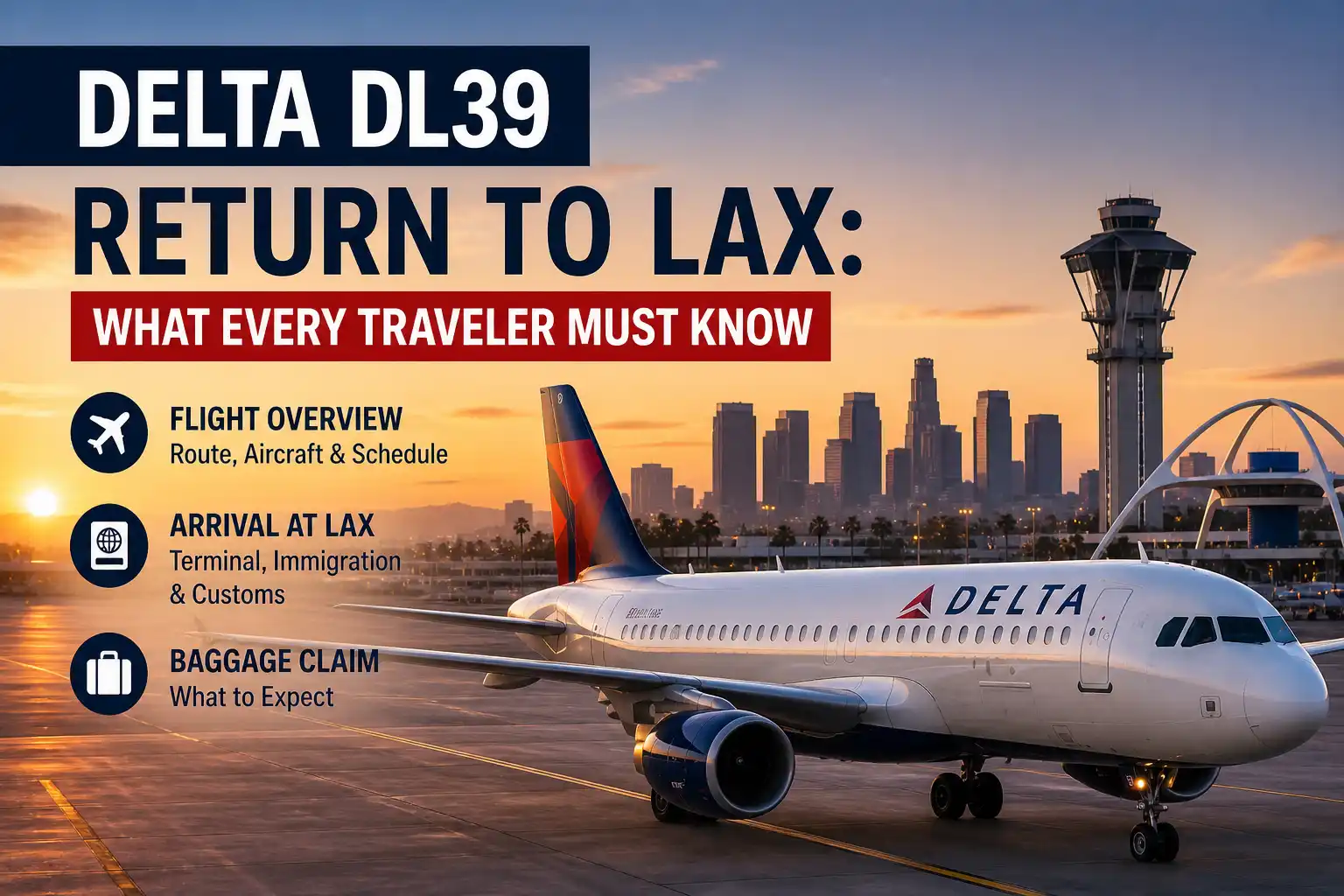

On August 13, 2025, Delta Air Lines flight DL39 made headlines for all the wrong reasons. The flight departed Los Angeles International Airport bound for Shanghai — and came back nearly nine hours later without ever reaching China. The Delta DL39 return to LAX incident caught the attention of aviation watchers, stranded passengers, and curious travelers worldwide — sparking genuine curiosity and concern across the industry.
- What Is Delta Flight DL39 and Its Route?
- What Happened: The Delta DL39 Return to LAX Incident
- Common Reasons a Flight Like DL39 Returns to LAX
- The Real-Time Decision-Making Process Behind a Return
- The Airbus A350-900: The Aircraft Used for DL39
- Passenger Experience During and After the Return
- Your Rights as a Passenger During a Flight Diversion
- How Delta Handles Diversions Operationally
- How the Return Affects the Airline
- Comparing Delta DL39 to Other Long-Haul Pacific Routes
- Safety Procedures at LAX for Returning International Flights
- Practical Tips for Passengers on Long-Haul Flights Like DL39
- Conclusion
- FAQs
- FAQ 1: Why did Delta flight DL39 return to LAX?
- FAQ 2: Why did the flight return to LAX instead of diverting to another airport?
- FAQ 3: How long was the total flight time for the DL39 return incident?
- FAQ 4: What are my passenger rights if my flight returns to the departure airport?
- FAQ 5: What should I do immediately if my flight turns around mid-air?
- FAQ 6: Does travel insurance cover a flight diversion like DL39?
- FAQ 7: How long does it take for a diverted flight to depart again?
- FAQ 8: Is the LAX to Shanghai route on Delta safe to fly?
Behind every flight return lies a network of systems, human judgment calls, and protocols built around one principle: safety above all else. What happened with DL39 is a study in operational excellence under uncertainty — and a reminder of how quickly routine long-haul journeys can change direction in modern air travel.
This guide breaks down exactly what happened, why the crew made the call to turn around, and what it means for anyone flying this route.
What Is Delta Flight DL39 and Its Route?
Flight DL39 operates between Los Angeles (LAX) and Shanghai Pudong International Airport (PVG). Delta runs this trans-Pacific service three times per week — on Wednesdays, Fridays, and Sundays — using the Airbus A350-900, one of the most capable long-haul jets in commercial aviation.
The route covers approximately 6,480 miles and typically takes 13 to 15 hours in the air. Because of that distance, every aspect of the flight — fuel load, crew scheduling, passenger management, routing — is planned carefully in advance. It’s part of Delta’s broader global network connecting the western United States to major destinations in the Asia-Pacific region.
| Flight Detail | Information |
| Flight Number | DL39 / DAL39 |
| Route | Los Angeles LAX → Shanghai PVG |
| Aircraft | Airbus A350-900 (Reg. N504DN) |
| Distance | ~6,480 miles |
| Typical Duration | 13–15 hours |
| Frequency | 3x weekly (Wed, Fri, Sun) |
What Happened: The Delta DL39 Return to LAX Incident
At 11:52 PDT on August 13, 2025, DL39 lifted off from runway 24L at LAX. Everything appeared routine. The Airbus A350-900, registered N504DN, climbed out over the Pacific and headed west toward China.
Then, roughly four hours into the flight and well over the middle of the Pacific Ocean, the situation changed. A passenger began behaving in a way that threatened the safety and order of the cabin. The crew reported the misconduct to the cockpit, and after evaluating their options, the pilots executed a mid-air U-turn — a decision that was widely shared online within hours of the aircraft landing.
The aircraft touched down on runway 24R at LAX approximately nine hours after departure — a full workday spent in the air going nowhere. Law enforcement met the plane on arrival. The disruptive passenger was removed, and Delta began working to get the flight back in the air.
Step-by-Step Timeline of the Event
- Passengers boarded at LAX; DL39 departed normally at 11:52 PDT
- Aircraft climbed from runway 24L, headed west over the Pacific
- Roughly 4 hours in, a passenger caused a serious cabin disturbance
- The flight crew reported the situation to the cockpit
- Pilots assessed options and elected to return to Los Angeles
- DL39 landed safely on runway 24R, ~9 hours after departure
- Law enforcement boarded; a disruptive passenger was removed
- Delta coordinated rebooking and passenger support
- Flight eventually re-departed toward Shanghai
Why the Pilots Chose to Return to LAX Instead of Diverting
Mid-Pacific, there aren’t many options. The nearest diversion airports are sparse, and landing at a smaller facility would have created significant logistical problems — limited maintenance crews, fewer spare aircraft, and little to no infrastructure to rebook hundreds of passengers.
Returning to LAX gave Delta access to its full hub resources: mechanics, replacement aircraft if needed, fresh crew, police for the removal, and a complete passenger support operation. It’s the kind of decision that costs time but solves the problem cleanly.
Common Reasons a Flight Like DL39 Returns to LAX
A return decision on a long-haul flight is never made lightly. It results from careful evaluation across multiple dimensions — aircraft status, crew assessment, passenger safety, fuel state, and available diversion options all factor into the final call.
Mechanical Issues
Modern aircraft like the A350-900 constantly monitor themselves. Hundreds of sensors track engine performance, hydraulics, pressurization, and more. If a system irregularity or sensor warning appears — even a minor anomaly — pilots may elect to return rather than press on over thousands of miles of open ocean. Airlines operate with zero-risk tolerance when it comes to mechanical unknowns.
Medical Emergencies
A passenger experiencing a serious health crisis mid-flight may need care that the cabin simply can’t provide. The onboard medical resources available to crew — first aid kits, AED devices, and the assistance of any medical professionals among passengers — have real limits. When those limits are reached, this becomes a critical factor in the return decision. If the crew determines that a medical emergency requires immediate hospital-level treatment, returning to a major airport with full emergency services is often the fastest path to getting that person proper help.
Passenger Misconduct
This was the trigger for the DL39 incident. When a passenger refuses to follow crew instructions, becomes aggressive or violent, or creates an environment where others feel genuinely unsafe, the cabin crew has few good options at 35,000 feet. Disruptive behavior can range from yelling and verbal threats to physical aggression — and in some cases, passengers who have consumed too much alcohol become impossible to manage safely in a confined cabin environment. There’s no pulling over. Returning to an airport with police and legal authority is often the only responsible move.
Consequences for disruptive passengers are serious: federal fines, lifetime flight bans, and criminal charges are all possibilities.
Operational and Weather Constraints
Air traffic control restrictions, severe weather at the destination, unexpected airport closures, or fuel calculation issues can all force a return. Fuel planning for a trans-Pacific flight leaves some margin, but not unlimited flexibility — and continuing into a deteriorating situation over open ocean carries real risk.
The Real-Time Decision-Making Process Behind a Return
What makes a turn-back on a long-haul flight remarkable isn’t just the decision itself — it’s how fast it happens. The cockpit crew doesn’t act alone. Pilots communicate with air traffic control and airline dispatch simultaneously. Ground teams and a dedicated operations war room staffed by logistics experts monitor the situation in real time.
Within minutes, the crew evaluates their options: divert to an alternate airport, continue to the destination, or return to the origin. Each choice gets weighed against the current fuel state, crew duty limits, aircraft status, and the nature of the problem.
The structured process — built on training, technology, and clear protocols — is what turns a chaotic situation into a controlled response. From a passenger’s seat, it may look like uncertainty. From the cockpit, it’s a practiced system working exactly as designed.
The Airbus A350-900: The Aircraft Used for DL39
Delta operates the Airbus A350-900 on the LAX–Shanghai route for good reason. The aircraft assigned to the DL39 route — registered N504DN — was purpose-built for intercontinental flying. Its airframe uses lightweight composite materials that improve fuel efficiency and allow it to cover distances other jets can’t match without a stop.
The cabin experience on the A350 is noticeably different from older wide-body aircraft. Larger windows, improved air humidity, lower cabin pressure altitude, and specially tuned LED lighting that adjusts to reduce jet lag all reduce the physical fatigue of a 13-hour flight. The engines are significantly quieter, and the onboard technology — including advanced avionics, real-time weather displays, and health monitoring systems — gives pilots a clear, current picture of everything happening with the aircraft.
Even in the event of an engine anomaly, the A350 is certified for extended twin-engine operations (ETOPS) over remote ocean routes, meaning it can continue safely to a suitable airport on a single engine.
Passenger Experience During and After the Return
What It Feels Like Onboard
Most passengers won’t know something is wrong until the captain makes an announcement — and even then, the information shared is often brief. The seatback map suddenly shows the plane curving back east. Announcements are measured and calm, focused on keeping people informed without triggering panic.
Passengers may notice the flight path shift, a delay in reaching or maintaining cruising altitude, or emergency services visible on the ground upon arrival. While disorienting, these are signs that the safety system is working.
What Happens After Landing at LAX
Once the aircraft is assigned a gate and parks at the international terminal, things move quickly:
- The disruptive passenger is removed by law enforcement
- Crew members complete written reports documenting the incident
- Maintenance teams inspect the aircraft; a replacement aircraft is sourced if the original requires extended servicing
- Delta staff arrange rebooking on alternative routes where direct re-departure isn’t immediately possible, along with meal vouchers and hotel accommodation if needed
- Ground crew prepares the aircraft for re-departure
- Passengers receive updated gate and flight information via the Fly Delta app
Your Rights as a Passenger During a Flight Diversion
If a flight returns to its origin and your total delay to the destination exceeds six hours, U.S. Department of Transportation rules entitle you to a full refund to your original payment method — even if the airline eventually re-flies the route.
Beyond refunds, airlines must provide “duty of care,” — which means food, water, and overnight accommodation when warranted. Keep every receipt for out-of-pocket expenses; reasonable costs can often be reimbursed.
Travel insurance with trip interruption coverage fills the gaps the airline won’t. A missed prepaid hotel in Shanghai or a cancelled business meeting are the kinds of losses DOT rules don’t cover, but a solid insurance policy often does.
If your flight is disrupted, open the Fly Delta app immediately. Rebooking often happens automatically before the plane even lands. If the app isn’t resolving your situation, look for a Delta Help desk in the terminal — these agents are specifically trained to assist passengers whose travel has been disrupted by a diversion or turn-back.
How Delta Handles Diversions Operationally
Delta runs a coordinated operations war room that activates the moment a diversion is confirmed. Teams source replacement aircraft if necessary, arrange a fresh crew when duty-hour limits have been hit, and push communication updates through the app, text message alerts, and gate screen displays faster than most passengers expect.
The DL39 incident is a useful example of how efficiently this can work. After the disruptive passenger was removed, Delta re-cleared the aircraft, arranged a new crew configuration, and had DL39 back in the air within hours — eventually resuming its journey toward Shanghai. In most diversion scenarios, Delta aims to get passengers moving again within 12 to 24 hours, depending on the nature of the original disruption.
How the Return Affects the Airline
Operational and Financial Costs
| Cost Category | What It Means |
| Fuel | Extra hours of flying = high added cost |
| Crew | Extended duty may require a fresh crew at overtime rates |
| Passenger care | Hotels, meals, and rebooking across hundreds of travelers |
| Aircraft scheduling | Downstream flights may be delayed or reassigned |
| Ground operations | Unplanned gate use, handling, and support staffing |
Beyond direct costs, the block time is extended significantly — the aircraft logs hours that generate no revenue and push subsequent scheduled flights out of position.
Why Airlines Still Choose Safety Over Cost
Every one of those costs is real, and airlines absorb them willingly. The alternative — continuing a flight with a compromised cabin situation over a featureless ocean — introduces risks that no cost-benefit analysis justifies. Safety always wins.
Airlines like Delta plan for these emergencies well in advance. Operational resilience is built into their systems through spare aircraft pools, standby crew rosters, and pre-established diversion protocols. This proactive approach is part of what makes commercial aviation the safest form of mass transportation in the world. The long-term outcomes of maintaining this standard — passenger trust, regulatory compliance, brand reputation — far outweigh the short-term cost of any single diversion. A decisive response to disruption, executed quickly and professionally, defines how an airline is ultimately judged.
Comparing Delta DL39 to Other Long-Haul Pacific Routes
The LAX–Shanghai corridor is served by nine airlines operating roughly 56 weekly flights. United Airlines, China Eastern, and Air China all fly similar long-haul routes under the same international safety standards. Across the route, approximately 80% of flights arrive on time, with an average delay of around 297 minutes when disruptions do occur.
One key difference between Pacific routes and flights to Europe, South America, or Australia is the limited number of diversion airports available mid-flight. Flights to Europe cross populated landmasses with dozens of suitable airports within reach at any time. Routes to South America and Australia face similar oceanic stretches, but the Pacific crossing to China is among the longest and most remote of any commercial route in the world, making return-to-origin decisions more common than diversions to third airports.
What distinguishes DL39 specifically is Delta’s large hub presence at LAX and its use of the A350-900 — a newer, more capable aircraft than what some competitors deploy on the same route.
Safety Procedures at LAX for Returning International Flights
Los Angeles International Airport maintains dedicated emergency response resources for returning flights. When a flight signals an inbound diversion or return, the airport activates its standard response: fire crews position near the runway as a precaution, a gate is cleared in the international terminal, and law enforcement is staged and ready.
Even at one of the most crowded airports in the world, LAX manages these situations efficiently. Gate coordinators work around active aircraft traffic to clear a path for the returning flight without disrupting the broader operation.
For most returns — including the DL39 incident — this process is smooth and fast. Customs and immigration teams process passengers whose travel plans have changed. Automated passport control kiosks handle returning U.S. citizens quickly.
Practical Tips for Passengers on Long-Haul Flights Like DL39
A nine-hour round trip to nowhere is exhausting. A few habits can make a disrupted long-haul flight significantly more manageable:
- Keep essentials in your carry-on: medication, a phone charger, a change of clothes, and a toothbrush. If your checked bag is delayed, you’ll be comfortable
- Stay hydrated: long flights dehydrate the body, and stress makes it worse — take slow, deep breaths to stay calm during unexpected announcements
- Download the Fly Delta app before departure and connect to onboard Wi-Fi: it’s the fastest way to receive rebooking updates, new gate and arrival terminal information before you even land
- Stay positive and flexible: travel disruptions are rare but real. An expert traveler mindset means treating a turn-back as a manageable inconvenience rather than a crisis — and that positive mindset makes the whole experience easier, especially if you’re traveling with kids
- Keep receipts: if you buy food or need a hotel room during a disruption, documented expenses support reimbursement claims
- Follow crew instructions immediately: especially during an active disruption, crew instructions are safety-critical, not optional
- Inform family or your workplace: if a significant delay affects your schedule, a quick message saves unnecessary worry on both ends
Conclusion
The Delta DL39 return to LAX event in August 2025 was disruptive, expensive, and inconvenient for everyone on board. It was also handled correctly — with precision, caution, and trust in a system built specifically for moments like this. The pilots, crew, and Delta’s ground teams followed a clear, practiced protocol that prioritized every passenger’s safety over the schedule.
Understanding why flights turn back — and what to do when yours does — transforms a stressful experience into a manageable one. Modern aviation is designed with precisely these situations in mind, and the system, when everyone plays their part, works.
Safe travels on your next flight — whether it’s to Shanghai or anywhere else in the world.
FAQs
FAQ 1: Why did Delta flight DL39 return to LAX?
In August 2025, a passenger engaged in serious misconduct mid-flight over the Pacific Ocean. After assessing the situation, the pilots determined it wasn’t safe to continue and turned the aircraft back to LAX, where law enforcement removed the passenger upon landing.
FAQ 2: Why did the flight return to LAX instead of diverting to another airport?
Over the mid-Pacific, suitable diversion airports are limited. Returning to LAX gave Delta access to its full hub infrastructure — mechanics, spare aircraft, police, and a complete passenger support operation — making it the most practical and efficient choice.
FAQ 3: How long was the total flight time for the DL39 return incident?
The aircraft was airborne for approximately nine hours — roughly four hours heading toward China before turning back. Passengers effectively spent a full workday in the air without reaching their destination.
FAQ 4: What are my passenger rights if my flight returns to the departure airport?
Under DOT rules, if a diversion causes a delay of more than six hours on an international flight, passengers are entitled to a full refund. Airlines must also provide duty of care, including meals and hotel accommodation for overnight disruptions. Keep all receipts for potential reimbursement.
FAQ 5: What should I do immediately if my flight turns around mid-air?
Stay calm and listen to the crew. Open the Fly Delta app — it often processes rebooking automatically before the plane lands. Once on the ground, speak with gate agents about food vouchers, hotel arrangements, and your new flight options.
FAQ 6: Does travel insurance cover a flight diversion like DL39?
Most comprehensive travel insurance policies include trip interruption coverage. This can cover losses the airline won’t reimburse — like a prepaid hotel in Shanghai or a missed tour. For long, expensive international trips, travel insurance is a practical investment.
FAQ 7: How long does it take for a diverted flight to depart again?
It depends on the cause. A passenger removal can be resolved in a few hours once a crew refresh is arranged. A mechanical issue may ground the aircraft overnight. Delta typically aims to re-depart within 12 to 24 hours.
FAQ 8: Is the LAX to Shanghai route on Delta safe to fly?
Yes. Return events like this are rare relative to the thousands of successful DL39 flights operated each year. The Airbus A350-900 is one of the most reliable long-haul aircraft in commercial service, and the LAX–Shanghai route operates under strict international safety standards.