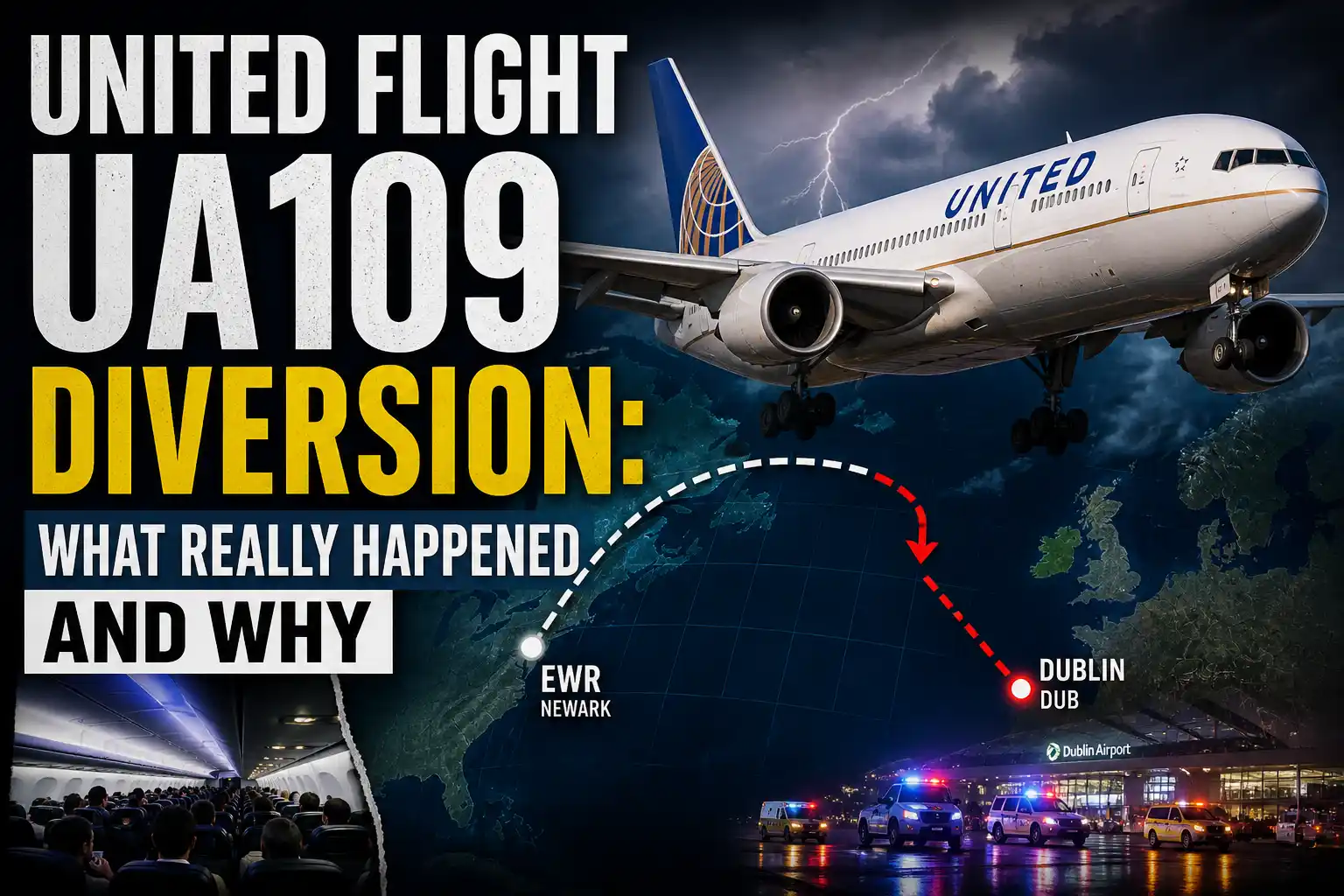

On October 30, 2025, the United Flight UA109 diversion caught the attention of thousands of people tracking flights online. A Boeing 787-8 Dreamliner operating between Munich and Washington Dulles suddenly turned around over the Atlantic — not because of a mechanical fault, not because of bad weather, and not because of any security threat. A cabin crew member developed a severe foot blister that prevented her from performing required safety duties. That single medical issue triggered a cascade of regulatory decisions that rerouted the aircraft to Dublin Airport in Ireland before it eventually completed its journey to Washington Dulles with roughly a two-hour delay.
- What Is United Flight UA109?
- Overview of the United Flight UA109 Diversion
- What Caused the United Flight UA109 Diversion?
- Timeline of the United Flight UA109 Diversion
- Why Dublin Airport Was Chosen for the Diversion
- Why the Pilots Decided to Divert the Flight
- Passenger Experience During the United Flight UA109 Diversion
- What Happened After Landing in Dublin
- How Airlines Handle Flight Diversions
- Aviation Safety and Regulatory Lessons from the Incident
- The Role of Flight Tracking Technology During the Diversion
- Impact on United Airlines Operations and Reputation
- How Common Are Flight Diversions?
- What Travelers Should Know About Flight Diversions
- Conclusion
- FAQs
- FAQ 1: What caused the United Flight UA109 diversion?
- FAQ 2: Was anyone in danger during the United Flight UA109 diversion?
- FAQ 3: Why did the pilots choose Dublin Airport for the diversion?
- FAQ 4: How long was the delay caused by the diversion?
- FAQ 5: Did passengers know what was happening during the diversion?
- FAQ 6: What happened to the crew member after landing in Dublin?
- FAQ 7: Could the flight have continued to Washington without diverting?
- FAQ 8: Are flight diversions common in aviation?
This article walks through exactly what happened, why the captain had no other legal option, and what the incident tells us about how modern aviation handles the unexpected. The incident highlighted how aviation safety protocols function when a crew member’s medical issue intersects with regulatory compliance mid-flight over the Atlantic.
What Is United Flight UA109?
UA109 is a United Airlines long-haul transatlantic service connecting Munich (MUC) to Washington Dulles (IAD). The flight covers the route in approximately 8–9 hours using the Boeing 787-8 Dreamliner, a wide-body aircraft purpose-built for intercontinental routes.
The route serves a mix of business travelers, tourists, and government officials crossing between Central Europe and the U.S. East Coast. United Airlines runs similar services from Newark to Frankfurt and Newark to London, making UA109 part of a broader North Atlantic network. The route also draws travelers making family visits and vacations, given its direct connection between two major international hubs.
Basic Flight Details
| Detail | Information |
| Airline | United Airlines |
| Flight Number | UA109 |
| Route | Munich (MUC) → Washington Dulles (IAD) |
| Aircraft | Boeing 787-8 Dreamliner |
| Registration | N28912 |
| Typical Duration | 8–9 hours |
| Incident Date | October 30, 2025 |
| Diversion Airport | Dublin Airport (DUB), Ireland |
Overview of the United Flight UA109 Diversion
UA109 departed Munich at 12:14 PM CET on a clear morning with no unusual conditions. About 90 minutes into the flight, cruising at approximately 40,000 feet over the Atlantic — roughly 600 nautical miles west of Ireland — a flight attendant reported a worsening medical situation.
The captain assessed the crew’s ability to legally continue the flight and determined it fell below the minimum staffing threshold required under FAA and EASA regulations. The aircraft performed a controlled U-turn over the Atlantic and was redirected east toward Dublin Airport, where it landed safely at approximately 3:00 PM GMT.
After a ground stop of around 80 minutes, UA109 departed Dublin at 4:20 PM and arrived at Washington Dulles at 6:15 PM local time — about two hours behind its original schedule. The Boeing 787-8 remained fully operational throughout. No mechanical failure, no security issue, no passenger emergency.
What Caused the United Flight UA109 Diversion?
The cause was a severe foot blister affecting a cabin crew member. The pain was significant enough to prevent her from standing and moving normally, which meant she could no longer perform the emergency duties that aviation law requires of every active crew member.
Those duties aren’t optional extras. They include:
- Guiding passengers to emergency exits under pressure
- Operating aircraft doors during an evacuation
- Coordinating first aid and managing passenger response
- Assisting with cabin safety procedures at any phase of flight
When a crew member cannot perform these tasks, the flight drops below the minimum staffing threshold defined by both the FAA and EASA. At that point, continuing the journey becomes a compliance violation — not a judgment call. The captain had a legal obligation to divert. The condition wasn’t life-threatening, but under international aviation law, it made the flight non-compliant.
Timeline of the United Flight UA109 Diversion
| Time / Event | Detail |
| 12:14 PM CET | UA109 departs Munich Airport on schedule |
| ~90 min–3 hrs in | Flight attendant reports severe pain from a foot blister; some crew accounts placed the report closer to 3 hours into the flight |
| Over the Atlantic | Captain decides to divert; U-turn performed at 40,000 ft |
| 3:00 PM GMT | Aircraft lands safely at Dublin Airport, runway 10L |
| 3:00 – 4:20 PM | Medical assessment, crew checks, operational clearances |
| 4:20 PM GMT | UA109 departs Dublin for Washington Dulles |
| 6:15 PM local | Flight arrives at Washington Dulles, ~2 hours delayed |
Aviation tracking network AIRLIVE published a live update at 14:55 local time confirming UA109 had landed on runway 10L and was met by emergency vehicles.
Why Dublin Airport Was Chosen for the Diversion
Dublin wasn’t selected at random. It’s a pre-planned diversion airport that appears in the dispatch documentation of most westbound transatlantic flights before they even leave the gate.
Strategic Location
Dublin sits directly along the major North Atlantic flight routes connecting Europe and North America. For any aircraft in the first two to three hours of a westbound crossing, it represents the closest and most practical option when something goes wrong. Turning back toward Dublin from mid-Atlantic adds far less flight time than pressing on to an airport in Canada or on the U.S. East Coast.
Medical Facilities
Dublin Airport maintains 24/7 access to professional emergency medical services. Ground-based medical teams can meet diverted aircraft immediately on arrival, which was essential given the nature of the UA109 situation. Dublin’s trained emergency teams are positioned specifically to respond to wide-body aircraft arrivals without delay. The crew member received prompt professional attention the moment the aircraft stopped.
Long Runways and Aircraft Capacity
The airport’s runway infrastructure handles heavy, wide-body aircraft without restriction — including fully loaded Boeing 787 Dreamliners arriving with a complete fuel load and a full passenger complement. That matters when a large intercontinental aircraft diverts unexpectedly.
ETOPS Certification
Transatlantic twin-engine flights operate under ETOPS — Extended-range Twin-engine Operational Performance Standards. These rules require that the aircraft remain within a defined flying time of at least one suitable alternate airport throughout the entire flight. Dublin holds an official ETOPS alternate designation, meaning it meets the specific facility, runway, and medical standards required under those regulations. For flights crossing remote regions and long ocean stretches far from any land-based airport, this designation is what makes Dublin a legally viable backup landing site when conditions change mid-flight. It’s not just convenient — it’s officially qualified.
Why the Pilots Decided to Divert the Flight
The decision came down to regulatory compliance, not preference. FAA and EASA standards both set a firm legal threshold for the minimum number of physically capable crew members on a long-haul transatlantic flight. Once the crew member’s condition was confirmed, she couldn’t continue her safety duties, and that threshold was breached.
Critically, the captain made the call while the aircraft was still within range of several European alternates. Had the crew waited another hour, the aircraft would have been deeper into the North Atlantic — farther from Dublin, farther from any suitable airport, and with fewer options available. Modern fly-by-wire systems and real-time navigation data make executing a controlled diversion efficient, but early decision-making is what preserves those options in the first place.
No schedule pressure overrides a safety compliance requirement. The diversion was the only legally and operationally sound response.
Passenger Experience During the United Flight UA109 Diversion
Most passengers were settled into their long-haul routines — watching films, eating, or sleeping — when the announcement came. The initial reaction in the cabin was a mix of surprise, confusion, and worry, particularly among those who had no context for why a transatlantic flight would suddenly change course.
The crew explained clearly that the aircraft would divert to Dublin for a safety-related reason and that the situation was under control. The cabin remained calm and largely peaceful despite the unexpected development. No emergency procedures were initiated. Passengers were asked to stay seated with seatbelts fastened while the aircraft changed course.
Aviation tracking platforms like FlightAware and FlightRadar24 showed the U-turn in real time, which sparked concern among people following the flight online. Social media posts sharing screenshots from tracking apps spread quickly, amplifying the concern felt by family members and observers on the ground. Onboard, however, the atmosphere stayed composed. Clear, early communication from the flight crew made a measurable difference. Passengers who later commented on the experience noted that the crew’s explanations were direct and that the composure of the team reduced anxiety considerably.
What Happened After Landing in Dublin
Medical staff met the aircraft on the ground at Dublin Airport. They assessed the crew member’s condition, confirmed she was medically stable, and determined that hospitalization wasn’t required. She received appropriate ground-based treatment for the pain.
While the assessment took place, passengers remained on the aircraft. The ground team completed operational checks, refueled as needed, and verified that the remaining crew could legally continue the flight to Washington Dulles. Once all clearances were confirmed, UA109 resumed its journey.
The total ground stop lasted approximately 80 minutes. The full two-hour delay included the time spent diverting, landing, handling the medical situation, and repositioning for departure.
How Airlines Handle Flight Diversions
The process UA109 followed reflects standard airline diversion protocol — nothing improvised, nothing unusual. Every step has a defined procedure:
- Situation assessment — Crew and pilots evaluate the nature and severity of the issue
- ATC notification — Air traffic control is informed, and a revised routing is cleared
- Diversion airport selection — The nearest suitable airport with required facilities is identified from pre-planned alternates
- Passenger communication — Cabin crew deliver factual, calm updates
- Emergency services preparation — Ground teams at the diversion airport are alerted ahead of arrival
- Post-landing evaluation — The airline determines whether to continue the flight, swap aircraft, or arrange alternative transport
Pre-planned alternate airports, including Dublin, are built into every transatlantic flight’s dispatch documentation before departure. These contingency plans account for a wide range of emergency scenarios — from crew incapacitation to technical issues — and allow for real-time assessment of the best diversion option without delay. The goal at every stage is minimal disruption to passengers while maintaining full regulatory compliance. The contingency plan existed before UA109 left Munich.
Aviation Safety and Regulatory Lessons from the Incident
UA109 produced no injuries, no aircraft damage, and no long-term operational disruption — and that outcome is the direct result of the system functioning exactly as designed. Several consistent principles stand out:
- Minimum crew compliance is a hard legal line. Even a single incapacitated crew member can make a flight non-compliant with safety regulations.
- Early diversion protects options. Acting while still within range of European alternatives kept the situation manageable.
- ETOPS planning is practical, not theoretical. Dublin’s designation as a certified alternate was the direct reason it was reachable when the situation arose.
- Crew health is a safety variable. Comprehensive training and operational skills matter, but physical well-being is equally integral to emergency management on long-haul flights.
The incident also prompted broader reflection across the industry on crew welfare protocols, particularly for extended transatlantic services.
The Role of Flight Tracking Technology During the Diversion
Real-time flight tracking platforms gave the public an unusually clear view of this diversion as it unfolded. In the digital age, diversions no longer happen quietly — aviation professionals and casual observers alike can follow a flight’s path as events develop.
Aviation enthusiasts and media outlets monitoring the flight on FlightAware and FlightRadar24 spotted the U-turn over the Atlantic within minutes and began sharing information across online communities. That transparency is generally valuable — it keeps the public informed and reduces speculation. But it also carries a risk. Some early reports incorrectly identified Washington as the intended destination and misread tracking data in ways that created brief but noticeable misinformation online. The Boston destination error that circulated in some posts was a direct result of tracking data misinterpretation.
Flight tracking improves public understanding of aviation events, but it works best alongside accurate, timely communication from the airline itself.
Impact on United Airlines Operations and Reputation
Operationally, the diversion introduced fuel costs, Dublin Airport handling fees, scheduling adjustments, and a cascading delay for passengers with connecting flights. These are expected consequences of any unplanned diversion and are factored into airline contingency planning.
United Airlines received broadly positive responses for how it managed the event — a reflection of the professionalism and customer service the airline demonstrated throughout. The transparent handling reinforced airline trust among those onboard and built a perception of United as a reliable carrier. Operationally, the airline also demonstrated resilience, returning the route to its regular schedule without modification. The Munich–Washington Dulles route resumed normal operations immediately, and the Boeing 787-8 involved returned to regular service without modification or extended grounding.
How Common Are Flight Diversions?
With over 100,000 commercial flights operating globally each day, diversions represent a small but consistent feature of aviation operations. Medical emergencies — involving passengers or crew — account for a significant portion of diversion events on long-haul routes.
Weather diversions occur more frequently on short-haul domestic services. Mechanical precautionary diversions are less common but tend to attract more media coverage. Crew-related medical diversions like this one are relatively rare, which explains part of why this particular event generated so much online interest.
Diversions are not failures. They are the safety net working correctly.
What Travelers Should Know About Flight Diversions
If your flight ever diverts, it’s a sign that the crew is following safety regulations — not a sign that something has gone catastrophically wrong. A few practical points worth knowing:
- Stay calm and follow crew instructions. They have the information and the training.
- Keep essentials in your carry-on — chargers, any required medications, and snacks reduce the impact of an unexpected ground stop.
- Most diversions resolve within two to three hours. UA109’s ground stop was 80 minutes.
- Airlines will arrange connections if a diversion causes a missed onward flight.
- Follow the airline’s guidance for rebooking, accommodation, or compensation claims.
Smart planning before any long-haul flight — keeping essentials accessible, knowing your airline’s rebooking policy — makes a diversion far less stressful. Flying remains the safest travel mode available, and events like UA109 demonstrate exactly why. Aviation in 2026 operates under some of the most rigorous safety systems ever developed. When a crew diverts a flight, they are doing exactly what the regulatory framework requires — and that’s the point.
Conclusion
The United Flight UA109 diversion on October 30, 2025, came down to one straightforward reality: a flight attendant’s severe foot blister prevented her from performing legally required safety duties, and FAA and EASA regulations gave the captain no legal alternative but to divert. The Boeing 787-8 was never in danger. The decision was made early, executed cleanly, and resolved professionally — medical attention on the ground in Dublin, passengers continuing to Washington Dulles with a two-hour delay, and normal operations resuming immediately.
The incident stands as a clear example of aviation safety systems working exactly as designed. Pilots, flight attendants, airport ground teams, and medical staff each played their part. When plans change at 40,000 feet, the goal stays constant: bring everyone home safely.
FAQs
FAQ 1: What caused the United Flight UA109 diversion?
A cabin crew member developed a severe foot blister that caused intense pain and prevented her from performing required emergency safety duties. This dropped the flight below the legal minimum crew count, making diversion the only compliant option.
FAQ 2: Was anyone in danger during the United Flight UA109 diversion?
No. The aircraft was fully operational throughout. The diversion was a regulatory precaution, not a response to any in-flight crisis. There was no passenger emergency, no mechanical failure, and no security threat.
FAQ 3: Why did the pilots choose Dublin Airport for the diversion?
Dublin is an officially designated ETOPS-certified alternate airport positioned directly along the North Atlantic corridor. It has 24/7 medical facilities, runways capable of handling the Boeing 787, and is one of the closest suitable airports for westbound transatlantic flights in their first few hours.
FAQ 4: How long was the delay caused by the diversion?
Approximately two hours in total. The aircraft landed at Dublin at 3:00 PM GMT, departed at 4:20 PM after an 80-minute ground stop, and arrived at Washington Dulles at 6:15 PM local time.
FAQ 5: Did passengers know what was happening during the diversion?
Yes. The crew made clear announcements explaining the medical reason for the diversion and kept passengers informed throughout the process. Calm, direct communication kept anxiety low and the cabin orderly.
FAQ 6: What happened to the crew member after landing in Dublin?
Medical staff met the aircraft immediately on arrival. They assessed her condition, confirmed she was medically stable, and provided appropriate ground-based treatment. Hospitalization was not required.
FAQ 7: Could the flight have continued to Washington without diverting?
No. FAA and EASA regulations require a minimum number of physically capable crew members on a long-haul transatlantic flight. With the crew member unable to perform her emergency duties, continuing would have constituted a direct violation of aviation safety law.
FAQ 8: Are flight diversions common in aviation?
They occur regularly across global aviation, though they represent a small fraction of daily flights. Medical issues — whether involving passengers or crew — are among the most common causes on long-haul routes. Most diversions, like this one, are resolved safely within a few hours.