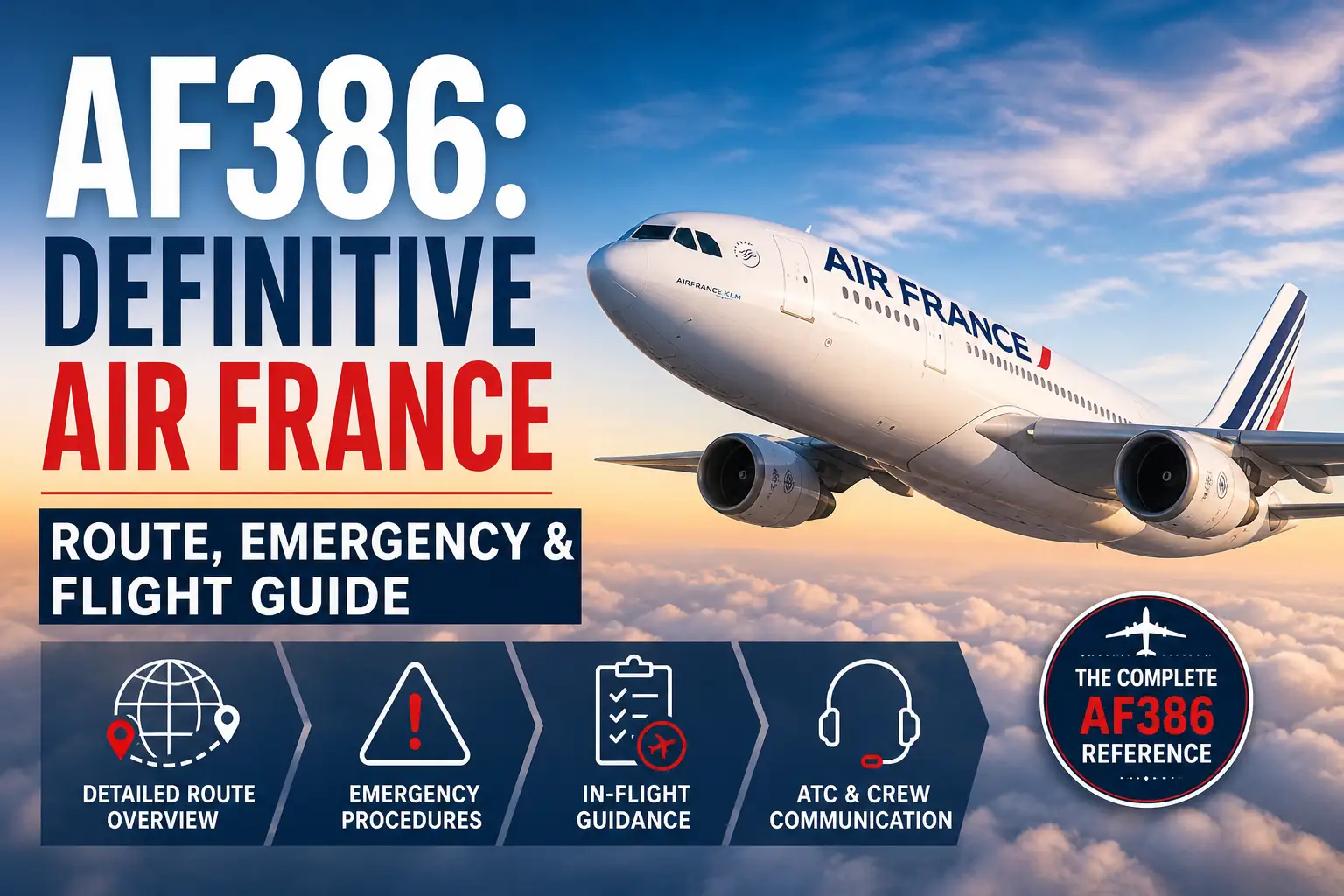

Air France flight AF386 — also referenced as AFR386 — connects Paris Charles de Gaulle (CDG) and Toronto Pearson (YYZ) on one of the busiest transatlantic corridors in aviation. For most passengers, it’s a routine long-haul journey. But on June 9, 2025, AF386 became one of the most closely watched flights in the world after its Boeing 777-300ER declared a midair emergency and turned back to Paris — all within hours of takeoff.
- What Is AF386? Flight Route, Schedule, and Key Details
- The AF386 Emergency — Full Sequence of Events
- About the Aircraft — Boeing 777-300ER F-GSQS
- Aviation Emergency Protocols — How AF386 Was Handled
- Operational Impact on Air France and CDG Airport
- Public Perception, Passenger Confidence, and Media Response
- Lessons for the Aviation Industry — From Crisis to Prevention
- AF386 Flight Delay, Compensation, and Passenger Rights
- Conclusion
- FAQs
- FAQ 1: What is Air France flight AF386?
- FAQ 2: What happened to AF386 on June 9, 2025?
- FAQ 3: Why did AF386 dump fuel over Normandy?
- FAQ 4: What aircraft operates AF386?
- FAQ 5: How long is the AF386 flight from Paris to Toronto?
- FAQ 6: Is AF386 a codeshare flight?
- FAQ 7: Can I claim compensation for an AF386 delay or cancellation?
- FAQ 8: What is the on-time performance of AF386?
The incident sent ripples across the global travel sector, raising fresh questions about aviation safety, aging fleets, and passenger confidence. Whether you’re tracking this flight, researching its history, or trying to understand what went wrong that evening, this guide covers everything in one place.
What Is AF386? Flight Route, Schedule, and Key Details
AF386 — sometimes listed as Air France 386 — is an international scheduled service operated by Air France between Paris Charles de Gaulle Airport (CDG) and Toronto Pearson International Airport (YYZ). It departs from Terminal 2E at CDG and arrives at Terminal 3 in Toronto. During its active season, the route runs daily operations, making it one of Air France’s core transatlantic services.
| Detail | Information |
| Flight Number | AF386 / AFR386 / AF0386 |
| Operator | Air France |
| Route | Paris CDG → Toronto YYZ |
| Flight Distance | 6,036 km / 3,751 miles |
| Average Flight Time | 8 hours 15 minutes |
| Average Flight Speed | 817 km/h |
| Departure Terminal | CDG Terminal 2E |
| Arrival Terminal | YYZ Terminal 3 |
| Aircraft Types Used | Boeing 777-300ER, Airbus A350-900 |
| On-Time Performance | 4.7/5 stars (Airportia) |
The flight also operates under four codeshare numbers: DL8634 (Delta), KL2036 (KLM), ME4358 (Middle East Airlines), and VS6682 (Virgin Atlantic). This means passengers booking through any of these airlines may technically be flying on AF386 without realizing it.
Historically, the route runs on a seasonal schedule, with service active through summer and reduced during off-peak months. About 30% of AF386 flights experience delays, with an average delay time of 65 minutes — a figure worth knowing if you have a connecting flight in Toronto.
The AF386 Emergency — Full Sequence of Events
On the evening of June 9, 2025, AF386 departed Paris Charles de Gaulle at 18:52 CEST bound for Toronto. The aircraft — a Boeing 777-300ER registered as F-GSQS — climbed normally toward its planned cruising altitude of 32,000 feet. Then, something went wrong.
As the aircraft entered its cruise phase, the flight crew encountered an unspecified technical fault. Within minutes, pilots declared a general emergency and began descending to FL300 (30,000 feet). Near Normandy, the crew entered a holding pattern and began dumping fuel to reduce the aircraft’s weight below its maximum landing limit. The 7700 squawk code — the universal aviation signal for a general emergency — lit up on radar screens across Europe.
The decision to return to Paris came quickly. By 20:15 CEST, it was confirmed: AF386 was heading back to CDG.
The aircraft touched down on runway 27L at 20:57 CEST, vacated via taxiway Y1, and returned to Terminal 2E by 21:08 CEST. No injuries were reported among the passengers and crew. The Boeing 777-300ER was grounded pending a full technical evaluation.
What stands out about this incident is how smoothly the crew executed the procedures. From emergency declaration to safe touchdown, the entire sequence took roughly two hours — a controlled, professional response to a high-pressure situation.
Timeline of Updates — Live Tracking the Emergency
| Time (CEST) | Event |
| 18:52 | AF386 departs Paris CDG |
| ~19:30 | Emergency declared near Channel Islands, 7700 squawk code activated |
| 20:10 | Aircraft circling at 30,000 feet, burning fuel over Normandy |
| 20:15 | Return to Paris CDG confirmed |
| 20:20 | Aircraft exits holding pattern, heads back to CDG |
| 20:50 | AF386 on final approach to runway 27L |
| 20:57 | Touchdown at Paris CDG |
| 21:08 | Aircraft returns to Terminal 2E |
| 21:10 | Technical issue confirmed by AIRLIVE via AirNav Radar data |
Aviation tracking platforms, including FlightAware, Flightradar24, and AirNav Radar, provided real-time data throughout the event. The 7700 squawk code remained active on radar screens until the aircraft touched down, allowing thousands of people to monitor the situation as it unfolded.
About the Aircraft — Boeing 777-300ER F-GSQS
The aircraft involved in the June 2025 incident, registered F-GSQS, is a Boeing 777-328ER — a specific variant of the broader 777-300ER family. According to data from Planespotters.net, it was delivered to Air France in January 2007, making it approximately 18.4 years old at the time of the emergency.
Air France operates 43 aircraft of the 777-300ER variant. Of those, 38 are in active service, and 5 are parked. The average fleet age across this variant sits at 16.8 years — older than many passengers might expect for a major transatlantic carrier.
Key specs for the 777-300ER in Air France configuration:
- Passenger capacity: 472 seats
- Freight capacity: 19.7 tonnes
- Role: Primary widebody for long-haul transatlantic routes
- Fleet status: Workhorse aircraft, gradually being supplemented by Airbus A350-900
It’s worth noting that aircraft age alone doesn’t determine safety risk — maintenance records and inspection cycles matter far more. But incidents like this one naturally prompt questions about whether aging widebody fleets receive the level of proactive scrutiny they need.
Aviation Emergency Protocols — How AF386 Was Handled
When pilots declare a general emergency, a precise set of procedures kicks in immediately. The flight crew of AF386 followed exactly this protocol, and the outcome reflects how well-designed these systems are.
Declaring a 7700 squawk code alerts every air traffic control center in the region. Controllers clear the airspace, prioritize the aircraft for landing, arrange runway clearance, and coordinate emergency response teams on the ground. In this case, CDG teams were ready long before the Boeing 777 touched down.
The decision to dump fuel over Normandy was also procedurally sound. The 777-300ER has a maximum landing weight significantly lower than its maximum takeoff weight. After a full fuel load for an 8-hour transatlantic flight, the aircraft was too heavy to land safely without first reducing that weight. The holding pattern and fuel burn phase over Normandy served exactly that purpose.
What AirNav Radar data confirmed was that the descent profile was controlled throughout — from FL300 down through FL180 before the base leg and final approach to runway 27L. There was no freefall, no sudden maneuver. Every stage was deliberate.
The entire response demonstrated strong coordination between the flight deck and CDG air traffic control, with slot recalibration at the airport happening simultaneously to accommodate the unplanned return. The AIRLIVE confirmation at 21:10 CEST closed the loop — technical issue identified, aircraft safely returned, aviation safety efficacy demonstrated under real pressure.
Operational Impact on Air France and CDG Airport
An emergency return of this scale doesn’t just affect one flight — it sends ripple effects through an entire operation.
F-GSQS was immediately taken out of service for post-emergency maintenance assessment. That meant the aircraft couldn’t be redeployed on its next scheduled rotation, forcing Air France to rearrange fleet resources. Passengers with onward connections from Toronto faced cancellations and rebooking delays, even though they never left Paris.
At CDG, the logistics shifted quickly:
- Emergency response teams were deployed to the runway
- Air traffic slot allocations were adjusted to accommodate the returning widebody
- Maintenance crews prepared for an inspection that would determine how long the aircraft stayed grounded
This kind of disruption highlights just how interconnected modern airline networks are. One grounded Boeing 777-300ER creates cascading operational consequences across multiple routes, airports, and connecting passengers — none of whom were on AF386 to begin with. The airline network interdependencies at play here are a routine reality of widebody operations, but they become painfully visible the moment an unscheduled return forces a technical evaluation mid-schedule.
Public Perception, Passenger Confidence, and Media Response
When the words “emergency” and “fuel dump” appear on live flight trackers and social media simultaneously, the public reaction is almost instant. Aviation trackers, news outlets, and worried travelers flooded platforms with questions within minutes. AF386 was no different.
Many passengers were already on edge following a period of heightened airline scrutiny — a year marked by reports of mechanical failures, near-miss collisions, and airspace conflicts across global carriers. Each new headline about a midair emergency chips away at the confidence travelers extend to airlines by default.
The emotional impact on those actually aboard AF386 shouldn’t be understated. Even with a professional crew managing the situation calmly, passengers experienced a significant shift from a routine flight to an emergency without full visibility into what was happening. That uncertainty feeds passenger anxiety more than the technical event itself.
Air France communicated that no injuries occurred and that the aircraft returned safely — factual, but minimal. In situations like this, passengers and the public often expect more: transparency about the cause, timelines for investigation, and clarity on what changes, if any, will follow.
Trust in air travel is rebuilt through action, not just reassurance. Live flight tracking tools have made these incidents far more visible than they were a decade ago, which means airlines now operate under constant real-time scrutiny from a global audience. Passenger trust erosion happens fast. Rebuilding it takes longer — and requires more than a press statement.
Lessons for the Aviation Industry — From Crisis to Prevention
AF386 landed safely. That’s the most important fact. But the incident raises legitimate questions that regulators and airlines need to answer honestly.
For the aviation industry, the key takeaways include:
- Inspection cycles: Are aging 777-300ER aircraft receiving thorough enough checks between flights?
- Technical fault detection: Can systems identify developing faults before they reach emergency thresholds?
- Preventive maintenance: Are airlines scheduling proactive checks, or waiting for symptoms to appear?
- Crew training: AF386’s crew performed correctly — regular drills clearly work, and that standard needs protecting
- Regulatory oversight: Both the European Union Aviation Safety Agency (EASA) and the Federal Aviation Administration (FAA) may review Boeing 777-300ER operational data in light of similar incidents across carriers
Post-pandemic travel surges have put enormous pressure on airlines to maximize fleet utilization. There’s a real tension between operational efficiency and safety standards — and when that balance shifts too far toward efficiency, incidents become more likely, not less.
Proactive maintenance isn’t a cost — it’s the foundation on which passenger trust is built. Aviation leadership across airlines and regulators must prioritize transparent evaluation after incidents like AF386. That shift — from reactive crisis management to genuine continuous improvement — is what the industry needs most right now.
AF386 Flight Delay, Compensation, and Passenger Rights
If your AF386 flight was delayed, cancelled, or affected by baggage issues, you may be entitled to compensation. The regulations that apply depend on your departure location and nationality.
| Regulation | Coverage |
| EC 261/2004 | EU departures — up to €600 compensation |
| UK261 | UK departures post-Brexit |
| Montreal Convention | International baggage claims |
| CA Montreal Convention | Canadian passenger protections |
| BR-ANAC | Brazilian passenger rights |
| SA-GACA | Saudi Arabian aviation regulations |
| TK-SHY | Turkish aviation passenger rights |
With AF386 showing a 30% historical delay rate and an average delay of 65 minutes, compensation claims are not uncommon. Eligible situations include:
- Delays over 3 hours on arrival
- Flight cancellations with less than 14 days’ notice
- Denied boarding due to overbooking
- Delayed, damaged, or lost baggage
Document everything — boarding passes, receipts for expenses during delays, and written communication from the airline. If your flight was cancelled, ask Air France directly about rebooking options before accepting a voucher, as cash compensation may still apply. Third-party compensation services can help if the airline disputes a claim directly.
Conclusion
AF386 landed safely. No injuries, no physical damage. That’s the most important fact. But the incident leaves behind important questions about aging fleet management, proactive maintenance, real-time technical monitoring, and how airlines communicate during crises.
When something goes wrong at 32,000 feet, the path back to public trust follows four steps: investigate, report, fix, and communicate. Airlines that skip any one of those steps invite media scrutiny that compounds the original damage.
Aviation safety works because it never stops improving. AF386 is one more data point in that ongoing process — a reminder that trust in air travel isn’t built in the sky. It’s built on the ground, in maintenance bays and training centers, long before wheels leave the runway.
FAQs
FAQ 1: What is Air France flight AF386?
AF386 is an international Air France flight operating between Paris Charles de Gaulle (CDG) and Toronto Pearson (YYZ). During its active season, it runs on a daily schedule. It is also available as a codeshare under Delta, KLM, Virgin Atlantic, and Middle East Airlines flight numbers.
FAQ 2: What happened to AF386 on June 9, 2025?
Shortly after departure from Paris, the Boeing 777-300ER (F-GSQS) operating AF386 developed a technical fault and declared a general emergency. The aircraft circled over Normandy to dump fuel, then returned safely to CDG. No injuries were reported.
FAQ 3: Why did AF386 dump fuel over Normandy?
The 777-300ER carries a full fuel load for an 8-hour transatlantic flight, which puts it well above its maximum landing weight. The aircraft descended to FL300 and entered a holding pattern over Normandy to burn and dump fuel until the weight dropped within safe landing limits — a standard emergency procedure for heavy widebody aircraft before returning to CDG.
FAQ 4: What aircraft operates AF386?
AF386 typically operates on a Boeing 777-300ER or Airbus A350-900 — both widebody aircraft suited for long-haul transatlantic routes. Air France operates 43 aircraft of the 777-300ER variant across its international network. The aircraft involved in the June 2025 emergency was F-GSQS, an 18.4-year-old Boeing 777-328ER delivered to Air France in January 2007.
FAQ 5: How long is the AF386 flight from Paris to Toronto?
The average flight time is 8 hours and 15 minutes, covering approximately 6,036 km (3,751 miles) at an average speed of 817 km/h.
FAQ 6: Is AF386 a codeshare flight?
Yes. AF386 — also referenced as AFR386 or AF 386 — is operated by Air France but sold under four additional flight numbers: DL8634 (Delta), KL2036 (KLM), ME4358 (Middle East Airlines), and VS6682 (Virgin Atlantic).
FAQ 7: Can I claim compensation for an AF386 delay or cancellation?
Yes, depending on your situation. Under EC 261/2004, passengers departing from EU airports may claim up to €600 for significant delays or cancellations. Other regulations — including UK261, the Montreal Convention, and Canadian rules — may apply depending on your route and nationality. Delays over 3 hours, cancellations with short notice, denied boarding, and baggage issues such as lost, delayed, or damaged luggage are all among the most common eligible claims.
FAQ 8: What is the on-time performance of AF386?
According to Airportia data, AF386 holds an OTP rating of 4.7 out of 5 stars. However, approximately 30% of its flights experience delays, with an average delay of 65 minutes — something to factor in when booking tight connections at Toronto Pearson.