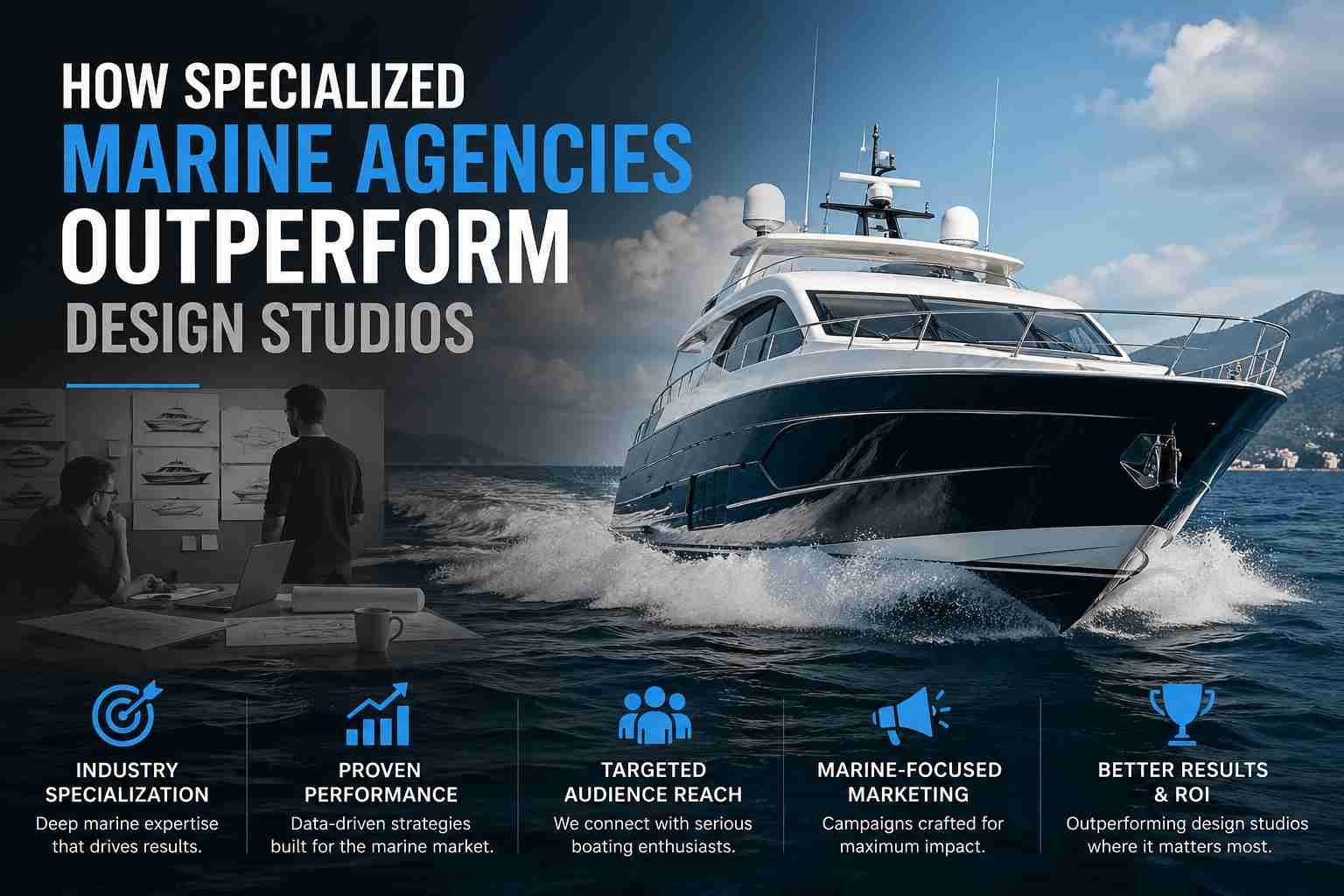

When a company operating in the marine sector decides to invest in brand identity, the first instinct is often to search for a well-reviewed design studio with a broad portfolio. The logic seems sound — experienced designers should be able to handle any industry. But the outcomes frequently tell a different story. Watercraft businesses, whether they manufacture vessels, operate charter fleets, provide marine engineering services, or sell marine equipment, consistently struggle when they work with studios that have no direct familiarity with their world.
- The Gap Between General Design and Industry-Specific Brand Identity
- Why Buyer Credibility Signals Differ in Marine Contexts
- The Practical Consequences of Misaligned Brand Identity
- How Niche Agencies Approach the Marine Sector Differently
- Regulatory and Standards Awareness in Brand Communication
- Segment-Specific Positioning Within a Broad Industry
- Long-Term Brand Consistency and Its Operational Value
- Evaluating Whether a Studio Has Genuine Marine Industry Experience
- Conclusion: The Strategic Case for Specialisation
This is not a question of creative talent. General design studios can produce attractive work. The problem is more fundamental: without an understanding of the marine industry’s operational realities, regulatory environment, and buyer expectations, even technically strong branding work tends to miss the mark in ways that are difficult to identify until the brand is already in circulation. By then, the cost — financial and reputational — is already absorbed.
Understanding why specialised agencies consistently outperform generalist studios for watercraft businesses requires looking at several factors that rarely appear in a standard design brief.
The Gap Between General Design and Industry-Specific Brand Identity
Brand identity design services are often presented as a universal skillset — a combination of logo creation, colour systems, typography, and visual guidelines that can apply to any organisation. While the technical process is transferable, the strategic thinking behind it is not. Effective brand identity is built on an accurate understanding of who the buyer is, what they trust, how they evaluate credibility, and what visual or verbal cues signal authority within a given professional context. A marine industry branding agency brings this contextual knowledge into the process from the outset, which changes not just the aesthetic output but the strategic foundation of the entire brand.
General studios tend to approach a new client by learning the industry during the engagement. This is a reasonable approach in many sectors where the buyer base is broad and general consumer logic applies. In the marine industry, it is a significant liability. The purchasing decisions for watercraft, marine equipment, and related services are made by professionals — fleet operators, marine engineers, procurement managers, port authorities — whose trust is built through very specific signals. Getting those signals wrong, or simply defaulting to visual conventions that feel borrowed from adjacent industries, produces a brand that fails to resonate with exactly the people it needs to reach.
Why Buyer Credibility Signals Differ in Marine Contexts
In most consumer markets, branding operates on familiarity and emotional appeal. In the marine industry, credibility is built on precision, reliability, and a demonstrated understanding of operational conditions. A buyer evaluating a marine equipment supplier or a vessel maintenance company is not making a decision based on how modern or energetic a logo looks. They are looking for evidence that the company understands the demands of working at sea — the regulatory requirements, the safety standards, the environmental conditions, and the consequences of failure.
When branding does not communicate these qualities — when it looks interchangeable with a logistics company or a general engineering firm — it creates uncertainty rather than confidence. The visual language of a brand in this context functions as a first-pass credibility filter. A general design studio without marine experience is unlikely to understand how that filter operates, because they have never observed how marine industry buyers read and evaluate the companies they consider working with.
The Practical Consequences of Misaligned Brand Identity
The consequences of misaligned branding in the marine sector are not always immediately visible. A poorly positioned brand identity does not necessarily prevent a company from winning business in the short term, particularly if that company has strong existing relationships or operates in a limited geographic market. The problems tend to emerge over time, as the company attempts to enter new markets, compete for larger contracts, or attract the attention of international buyers.
In those contexts, the brand is often the first and sometimes only point of contact. If it does not communicate fluency with the industry — its language, its standards, its concerns — the opportunity is lost before any conversation begins. Rebuilding brand identity after this pattern becomes clear is costly and disruptive, requiring design work, updated collateral, and a managed transition period that diverts attention from core operations.
How Niche Agencies Approach the Marine Sector Differently
The distinction between a niche marine branding agency and a generalist studio is not simply a matter of having worked with a few boat manufacturers. Genuine industry specialisation means the agency has developed a working knowledge of how marine businesses are structured, how procurement and partnership decisions are made, and how different segments of the industry — commercial shipping, recreational marine, naval, offshore — maintain distinct professional identities that require different brand strategies.
This depth of context changes how a brief is interpreted, how research is conducted, and how strategic recommendations are formed. A specialist agency does not need to spend the first phase of an engagement learning what a marine surveyor does or why a vessel classification society’s endorsement matters to a buyer. That knowledge is already embedded in the process, which means the time and budget spent on brand identity design services goes toward actual strategic and creative work rather than foundational industry orientation.
Regulatory and Standards Awareness in Brand Communication
The marine industry operates within a dense framework of international standards and regulations, many of which are governed by bodies such as the International Maritime Organization. These standards affect not only vessel operations but also the expectations and communication norms within the industry. Companies that supply to or operate within this framework are expected to demonstrate awareness of compliance and safety in how they present themselves.
A branding agency with marine experience understands that certain visual or verbal choices can signal either alignment with or indifference to these standards. This may seem subtle, but in a sector where safety and regulatory compliance are non-negotiable operational realities, a brand that inadvertently communicates carelessness — through overly casual design language or terminology that does not reflect industry norms — creates friction with the very buyers it is trying to engage.
Segment-Specific Positioning Within a Broad Industry
The marine industry is not monolithic. A company serving the commercial fishing sector operates in a very different professional environment than one serving superyacht owners, offshore energy operators, or port infrastructure clients. Each segment has its own buyer profile, its own set of trusted references, and its own visual and verbal conventions. Effective brand identity design services for a marine business must account for these distinctions rather than applying a generic maritime aesthetic.
Niche agencies understand these differences because they have worked across multiple segments and observed how positioning choices affect perception and conversion. They can advise a client on which conventions to adopt for credibility, which to deliberately deviate from for differentiation, and how to build a brand architecture that works across segments if the business operates in more than one. A generalist studio lacks this comparative reference point and is likely to produce branding that treats the entire marine industry as a single undifferentiated category.
Long-Term Brand Consistency and Its Operational Value
Brand consistency is often discussed in abstract terms, but in the marine industry, it has direct operational implications. Companies in this sector frequently operate across multiple geographies, maintain relationships with international partners and suppliers, and participate in industry events and certification processes where their brand is evaluated against peers. In these contexts, a brand that feels inconsistent — different in tone across markets, unclear in its positioning relative to competitors, or visually disconnected from industry norms — creates ongoing friction that compounds over time.
Consistent brand identity design services, delivered by an agency that understands the marine context, produce a foundation that holds up across these varied applications. The brand guidelines they develop are not just aesthetic rules but strategic documents that reflect an understanding of where and how the brand will be used, who will encounter it, and what it needs to communicate in each context.
The Cost of Rebranding Without Industry Guidance
Many watercraft businesses that initially worked with general design studios eventually find themselves in the position of needing to revisit their brand identity — not because the original work was poorly executed, but because it does not serve the strategic needs of the business as it grows or evolves. This process is expensive, not only in direct design costs but in the operational disruption of updating materials, communicating changes to existing clients and partners, and managing the transitional period when old and new brand elements coexist.
Avoiding this cycle requires getting the initial brand identity work right — not just technically, but strategically. That requires an agency that understands the marine industry well enough to anticipate where the business is likely to go and build a brand that can support that trajectory without requiring fundamental restructuring every few years.
Evaluating Whether a Studio Has Genuine Marine Industry Experience
The challenge for watercraft businesses evaluating branding partners is that industry experience is easy to claim and difficult to verify without asking the right questions. A studio may have worked on one marine project and present that as sector expertise. The relevant distinction is between an agency that has accumulated genuine knowledge of the industry — its buyers, its standards, its professional culture, and its competitive dynamics — and one that has simply applied general design skills to a maritime brief.
Useful indicators of genuine marine industry experience include the ability to discuss buyer psychology in specific marine segments without being prompted, familiarity with the regulatory and certification environment and how it affects brand communication, and evidence of having helped clients position themselves within the industry’s existing credibility frameworks. An agency that can only discuss aesthetics and process, without demonstrating strategic familiarity with the marine sector, is unlikely to produce brand identity work that goes beyond surface-level visual execution.
Conclusion: The Strategic Case for Specialisation
For watercraft businesses making decisions about brand identity investment, the choice between a generalist studio and a niche marine agency is not primarily a question of design quality. Both can produce technically competent work. The difference lies in the strategic depth that underlies the creative output, in whether the agency understands the industry well enough to make brand decisions that serve the business’s actual commercial and operational goals.
The marine industry’s buyers are professionals operating in demanding environments with clear expectations about credibility, reliability, and expertise. A brand that does not communicate fluency with those expectations will consistently underperform, regardless of how well-crafted it appears.
Brand identity design services delivered by an agency with genuine marine sector knowledge reduce that risk significantly, producing a foundation that holds up under real-world conditions and supports business development in the markets and segments that matter most.
The cost of getting this wrong is not always visible immediately, but it accumulates — in missed opportunities, in rebranding cycles, and in the ongoing friction of presenting a brand that does not quite fit the professional environment in which it operates. Choosing the right partner from the outset is the more reliable and ultimately more cost-effective approach.