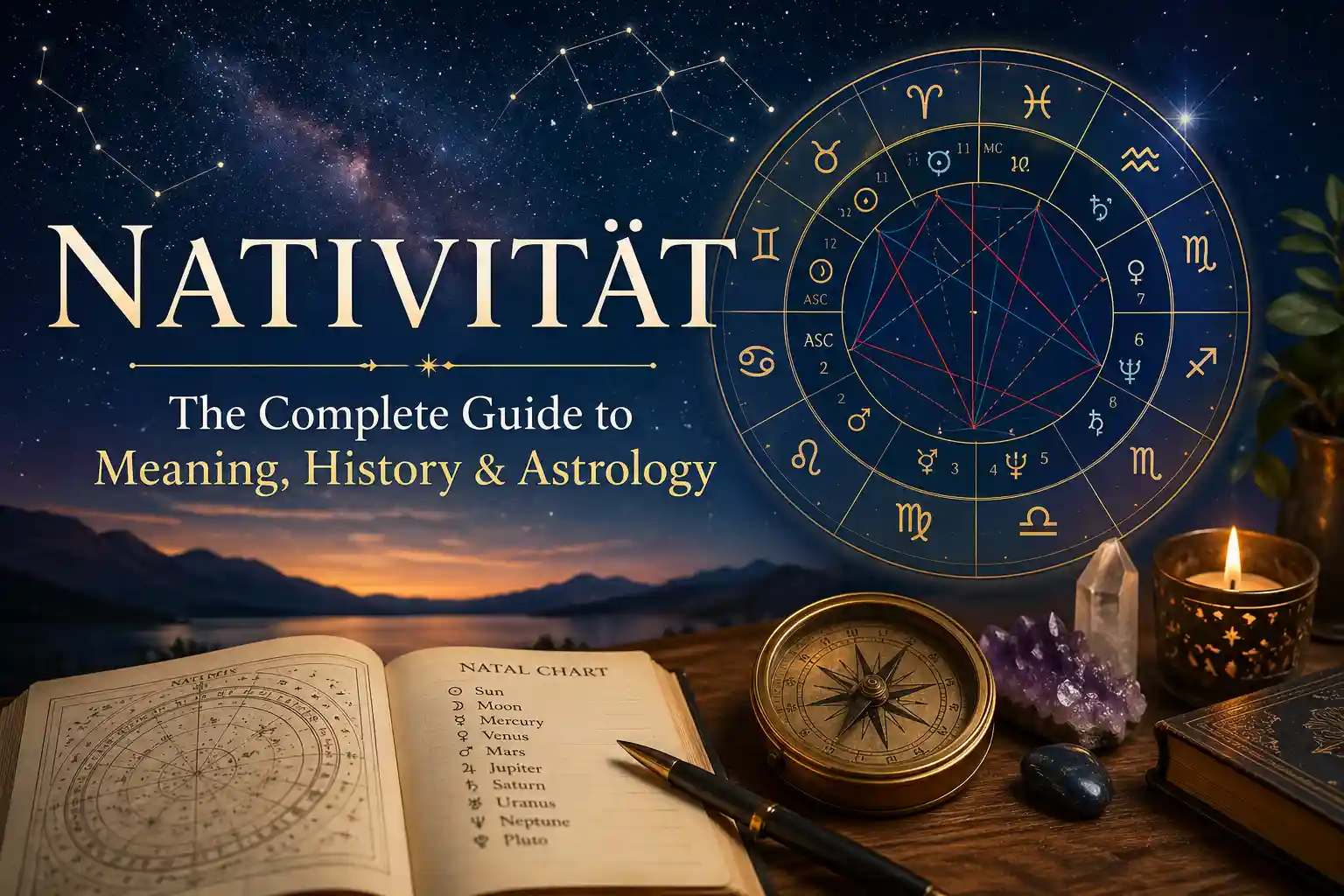

Nativität is a German word rooted in the Latin nativitas, meaning “birth.” It carries two major layers of meaning: the Christian celebration of the birth of Jesus Christ, and the astrological concept of the natal chart — a precise map of the sky at the exact moment a person is born. Beyond these two core uses, the term also appears in historical population records, philosophy, and natural science.
- What Does Nativität Mean?
- The Latin and Linguistic Roots of Nativität
- Nativität in Christian Tradition
- Nativity Scenes: History and Cultural Tradition
- Nativität in Art and Creative Expression
- Nativität Across Different Cultures
- Symbolism of Nativität
- Nativität in Astrology: The Natal Chart
- What Is a Natal Chart?
- Zodiac Signs and Key Elements
- Historical Roots of Natal Astrology
- Nativität vs Horoscope
- Nativität Beyond Religion and Astrology
- Nativität in Modern Society and Social Identity
- Heritage, Identity, and Genealogy
- Cultural Preservation and Digital Documentation
- Displacement and Heritage
- Nativität and Modern-Day Celebrations
- Why Nativität Still Matters Today
- Conclusion
- FAQs
- FAQ 1: What does Nativität mean in German?
- FAQ 2: What is the connection between Nativität and astrology?
- FAQ 3: What is the difference between Nativität and Nativity?
- FAQ 4: What information is needed to create a Nativität chart?
- FAQ 5: Is Nativität only a Christian term?
- FAQ 6: What does “Jemandem die Nativität stellen” mean?
- FAQ 7: Why is the Nativity important in the Christian faith?
- FAQ 8: How is Nativität celebrated across different cultures?
This guide covers every dimension of Nativität clearly and completely.
What Does Nativität Mean?
The word comes from the Latin root natus, meaning “born,” and nativitas, meaning “birth” or “origin.” In German, Nativität holds at least three distinct meanings depending on the context in which it appears:
| Context | Meaning |
| Christian / Religious | Birth of Jesus Christ; the Nativity is celebrated at Christmas |
| Astrological | The natal chart — position of stars and planets at the moment of birth |
| Historical / General | Moment of birth; once used in population statistics to mean birth rate |
One older German expression connected to this word is “Jemandem die Nativität stellen,” which literally means to cast a natal star chart for someone based on their birth moment. This phrase shows how deeply the astrological use of the term was embedded in German-speaking culture centuries ago.
The word is not limited to religious or astrological circles. Historically, it appeared in census records, theological texts, and philosophical writing as a universal idea centered on birth as a defining moment.
The Latin and Linguistic Roots of Nativität
Understanding the full scope of Nativität starts with its etymology. The Latin verb nasci means “to be born,” and from it came nativitas — a word adopted across multiple European languages, each maintaining the same core meaning:
- English: Nativity, native, natural, nation
- French: Nativité
- Italian: Natività
- Spanish: Natividad
- German: Nativität
Every one of these words carries the same cosmological and spiritual idea — birth as a threshold moment. The concept is not just physical. Across theological, astrological, and philosophical traditions, the moment of birth has long been treated as the point that shapes identity, personality, and destiny.
Nativität in Christian Tradition
The Biblical Accounts
The Christian Nativity is documented primarily in two Gospels of the New Testament — Matthew and Luke — each offering a different perspective on the same event.
Matthew’s account traces Jesus’ genealogy back through the house of David, emphasizing royal lineage. An angel appears to Joseph in a dream and reveals that Mary’s pregnancy is the work of the Holy Spirit. Matthew also introduces the Magi — Three Wise Men from the East — who follow a star to Bethlehem and present gifts of gold, frankincense, and myrrh to the newborn.
Luke’s account provides more narrative detail. Mary and Joseph travel from Nazareth to Bethlehem for a Roman census, arriving to find no room at the inn. Jesus was born in a stable and placed in a manger. Shepherds, informed by angels, visit the child. The message delivered — peace on earth, goodwill to all — remains the emotional center of the Christmas season.
Both accounts converge on one location: Bethlehem. And both treat this birth not as an ordinary event, but as a moment of fulfillment — one that connected the joy of new life with the weight of ancient prophecy.
Theological Importance
For Christians, Nativität represents the Incarnation — the theological belief that God entered the world in human form through Jesus Christ. This was not a birth into wealth or power. Jesus arrived in a stable, born to a poor family, and placed in a manger.
That deliberate humility carries theological meaning. It signals solidarity with the marginalized and demonstrates that divine love operates outside social status. The Gospel of Luke frames this birth as the fulfillment of Old Testament prophecies concerning the Messiah, the one who would bring salvation and reconciliation to humanity.
The Incarnation remains the defining doctrine that separates Christianity from other Abrahamic faiths. Nativität is where that doctrine begins.
Nativity Scenes: History and Cultural Tradition
The nativity scene — called Krippe in German — is one of the most enduring visual symbols associated with Nativität. It typically includes figures of the Holy Family: Mary, Joseph, and the infant Jesus, along with shepherds, angels, the Three Wise Men, and animals.
The tradition of recreating this scene dates to 1223, when Saint Francis of Assisi set up the first live nativity in Italy during the Middle Ages. His goal was practical — he wanted to make the Nativity story accessible to people who could not read the Bible. Using real people and animals, he brought the story into the physical world.
Over the following centuries, this tradition spread across Europe. Artisans began crafting detailed figures from wood, clay, and porcelain. In Germany, especially, hand-carved nativity figures became treasured family heirlooms, displayed in homes and churches throughout the Christmas season. Today, nativity scenes appear in public spaces worldwide — not just as decoration, but as focal points for reflection and community gathering.
Nativität in Art and Creative Expression
Few subjects in art history have received as much sustained attention as the Nativity. Artists across centuries have returned to this moment to explore themes of light, vulnerability, and divine presence.
Giotto, Fra Angelico, Botticelli, and Caravaggio each produced iconic Nativity paintings — not as simple illustrations, but as deeply considered theological statements. The recurring visual element across their work is light emerging from darkness, often concentrated on the child in the manger.
Beyond painting and sculpture, Nativität has inspired:
- Nativity plays have been performed in churches and schools since the medieval period
- Film adaptations that retell the story for modern audiences
- Christmas carols — Silent Night and O Holy Night remain among the most performed pieces of music globally
- Presepi viventi — Italy’s tradition of living nativity scenes, where entire villages reenact the story with real participants
These creative expressions are not merely cultural products. Each one functions as a vehicle for transmitting the core message of Nativität to new generations.
Nativität Across Different Cultures
European Traditions
In Germany, Nativität is woven into the fabric of the Christmas season. Weihnachtsmärkte (Christmas markets) feature elaborate Krippe displays. Homes set up nativity figures, and the tradition of the Christkind — the Christ Child who delivers gifts on Christmas Eve — ties gift-giving directly back to the Nativity story. Advent calendars mark the days leading up to the celebration, building anticipation in the weeks before December 25.
Midnight Mass remains a central ritual across German-speaking countries, blending solemnity with festivity in a way that few other religious services replicate.
Global Cultural Expressions
In Mexico, the tradition of Las Posadas reenacts Mary and Joseph’s search for shelter in Bethlehem. Communities organize processions through neighborhoods, enacting the request for hospitality that precedes the birth. The celebration emphasizes community, justice, and peace — values that extend beyond the religious narrative.
In Italy and Spain, nativity scenes include local villagers and farm animals alongside the biblical figures, grounding the universal story in familiar, everyday settings. Latin America more broadly integrates vibrant fabrics, local music, and regional imagery into its Nativity expressions. Parts of Asia hold early morning gatherings and prayers, adapting the tradition to local rhythms of worship and community life.
Symbolism of Nativität
Nativität carries a consistent symbolic core across every cultural and religious context in which it appears:
| Symbol | Meaning |
| Manger | Humility and simplicity |
| Star | Guidance, hope, destiny |
| Light in darkness | Renewal, potential, new beginning |
| Threshold of birth | Identity, the defining moment of existence |
| Sacred journey | Transformation, mission, purpose |
The Christmas star and the astrological natal chart both point toward the same idea — that the moment of birth carries meaning that extends far into a person’s life. Whether approached through theology or astrology, Nativität treats birth as the beginning of something larger than the individual moment itself.
Nativität in Astrology: The Natal Chart
What Is a Natal Chart?
In astrology, Nativität refers to the natal chart — also called a birth chart or horoscope. It is a 360-degree wheel divided into 12 houses, each corresponding to a zodiac sign. Planets are plotted onto this wheel to show which sign and house they occupied at the exact moment of a person’s birth.
Astrologers use this chart to interpret personality, strengths, challenges, and life path. Three pieces of information are required:
- Date of birth
- Exact time of birth
- Place of birth
The Ascendant (Rising Sign) changes every two hours, which is why birth time accuracy is critical for a precise reading. The key elements of a natal chart include:
| Element | What It Represents |
| Sun Sign | Core identity and ego |
| Moon Sign | Emotions, instincts, inner world |
| Ascendant (Rising Sign) | Outward personality |
| Midheaven (MC) | Career, public image, life purpose |
| Aspects | Angles between planets showing energy interaction |
Zodiac Signs and Key Elements
The 12 zodiac signs are grouped into four elemental categories, each adding distinct qualities to the planets placed within them:
- Fire Signs — Aries, Leo, Sagittarius: energy, confidence, enthusiasm
- Earth Signs — Taurus, Virgo, Capricorn: stability, practicality, groundedness
- Air Signs — Gemini, Libra, Aquarius: intellect, communication, social connection
- Water Signs — Cancer, Scorpio, Pisces: emotion, intuition, depth
Historical Roots of Natal Astrology
Casting a Nativität — reading the position of the heavens at the moment of birth — has ancient origins. The practice appears across Hellenistic astrology in ancient Greece and Egypt, in the systematic star records of Babylonian astronomy, and in the scholarship of the Islamic Golden Age, where Greek astrological texts were preserved and expanded. During the Medieval European tradition and into the Renaissance, natal charts were cast for kings, nobles, and clergy as standard practice.
Nativität vs Horoscope
| Feature | Nativität (Natal Chart) | General Horoscope |
| Based on | Exact birth date, time, and location | Sun sign only (birth month) |
| Specificity | Completely unique per individual | Shared by all born that month |
| Depth | Full planetary map with 12 houses | Single sign overview |
| Purpose | Deep personality and life path analysis | General weekly/monthly guidance |
Nativität Beyond Religion and Astrology
The concept of Nativität extends into several other fields that rarely get mentioned together:
Biology and natural science use the related term native to describe molecules or organisms in their original, unaltered state. A protein in its “native form” retains its natural structure — unchanged by external processes. This echoes the idea of birth as a state of purity and origin.
Population statistics historically used Nativität in German to mean Geburtenziffer — the birth rate of a population. Demographers, sociologists, and economists tracked Nativität alongside Geburtenrate and Fertilität to analyze how societies grow and change. These metrics directly inform policy decisions, economic forecasting, and urban planning.
Philosophy offers perhaps the most expansive use of the concept. Hannah Arendt introduced the term natality to describe humanity’s fundamental capacity for new beginnings — the idea that every person born into the world brings the potential for something genuinely new. This philosophical natality connects directly to the symbolic core of Nativität.
Nativität in Modern Society and Social Identity
Heritage, Identity, and Genealogy
The search for personal Nativität has grown significantly in the age of DNA testing and genealogy platforms. Younger generations are investing time in tracing ancestry, not simply out of curiosity but as a way to feel grounded in a globalized society where digital borders have replaced physical ones. Heritage tourism is rising — people want to visit the lands of their ancestors, to witness their origins firsthand. Schools are increasingly integrating local history into curricula, recognizing that a sense of belonging strengthens community spirit and academic engagement.
Cultural Preservation and Digital Documentation
Many indigenous languages face extinction, but AI tools developed in 2025 are actively archiving dialects before they disappear. Digital storytelling platforms allow families to record histories and preserve them in virtual vaults accessible to future generations. These tools bridge the ancient past with a high-tech future, ensuring that the specific cultural essence tied to a community’s Nativität is not permanently lost.
Displacement and Heritage
For communities forced to leave their homelands, maintaining a sense of Nativität becomes an act of cultural resistance. Refugee communities often recreate mini-homelands in new countries — neighborhoods defined by native customs, recipes, songs, and traditions carried from the place of origin. The essence of home, in this context, is preserved not in geography but in practice.
Nativität and Modern-Day Celebrations
Christmas remains the primary occasion through which most people encounter Nativität. Church services, public nativity displays, midnight Mass, and Christmas Eve services all bring the story into the present tense. Christmas carols — performed in homes, churches, and public spaces — carry the themes of the Nativity to audiences who may engage with the tradition culturally rather than religiously.
The commercialization of Christmas has created tension around this celebration. Gift-giving, holiday sales, and consumer culture increasingly dominate the season. For many Christians, the nativity scene serves as a deliberate anchor — a visible reminder of humility, goodwill, and divine love in the middle of commercial noise. The religious significance does not disappear under commercial pressure; it simply requires more intentional attention to maintain.
Why Nativität Still Matters Today
Nativität remains relevant because its core themes — birth, renewal, hope, and identity — are universal. They do not require religious belief to resonate. Anyone reflecting on their origins, seeking meaning in a new beginning, or working to preserve their cultural roots is engaging with something the concept of Nativität has always described.
Practically, the term matters across multiple fields: theology, astrology, demographics, philosophy, and cultural studies all use it as a framework for understanding how origins shape outcomes. Its emotional value — the sense of care, love, and life lessons embedded in the story of birth — gives it staying power in a fast-paced world that often prioritizes the new over the meaningful.
Mental well-being research consistently shows that people who understand their personal history feel more grounded and resilient. Nativität, in this sense, is not just a historical or religious concept. It is a structure for making sense of who we are and where we come from.
Conclusion
Nativität is one of those rare words that opens into something much larger the deeper you explore it. From the manager in Bethlehem to a medieval astrologer’s birth chart, from Renaissance paintings to modern natal chart calculators, the concept has been shaping how people understand birth, identity, and destiny for thousands of years.
Whether encountered through faith, astrology, art, philosophy, or history, its message stays consistent: every birth matters, and every beginning carries meaning. The timeless symbol of Nativität continues to connect divine love, cultural tradition, and human hope across every generation that encounters it.
FAQs
FAQ 1: What does Nativität mean in German?
Nativität is a German word derived from the Latin nativitas, meaning “birth.” It refers to the Christian Nativity (birth of Jesus Christ), the astrological natal chart, and historically, the birth rate in population statistics.
FAQ 2: What is the connection between Nativität and astrology?
In astrology, Nativität refers to the natal chart — a map of the sky at the exact moment, date, and location of a person’s birth. Astrologers use it to interpret personality traits, life paths, and key life themes.
FAQ 3: What is the difference between Nativität and Nativity?
They refer to the same concept in different languages. “Nativity” is English; “Nativität” is German. Both derive from the Latin nativitas and refer to birth, particularly the birth of Jesus Christ.
FAQ 4: What information is needed to create a Nativität chart?
An accurate natal chart requires the exact date, time, and place of birth. The Ascendant (Rising Sign) changes every two hours, so birth time accuracy is especially important for a precise reading.
FAQ 5: Is Nativität only a Christian term?
No. While strongly associated with Christian tradition, Nativität also refers to natal astrology, has historical uses in population statistics (Geburtenziffer), appears in natural science to describe native molecular forms, and connects to philosophy through Hannah Arendt’s concept of natality.
FAQ 6: What does “Jemandem die Nativität stellen” mean?
This older German phrase means “to cast someone’s natal chart” — to calculate the position of stars and planets at the time of a person’s birth for astrological interpretation.
FAQ 7: Why is the Nativity important in the Christian faith?
The Nativity represents the Incarnation — the theological belief that God entered the world in human form as Jesus Christ. It symbolizes humility, divine love, and hope, with Jesus born not in a palace but in a humble stable, signaling that God’s love extends to all people regardless of social status.
FAQ 8: How is Nativität celebrated across different cultures?
Celebrations vary widely. Germany holds Christmas markets (Weihnachtsmärkte) and displays Krippe. Italy and Spain feature elaborate nativity scenes with local figures. Mexico observes Las Posadas through neighborhood processions. Latin America integrates local music and fabrics. Across all traditions, Midnight Mass and Christmas carols remain common threads.